If Customized and National Support Funds Are Combined, the Total Scale Exceeds 30 Trillion Won... Payment Possible as Early as July
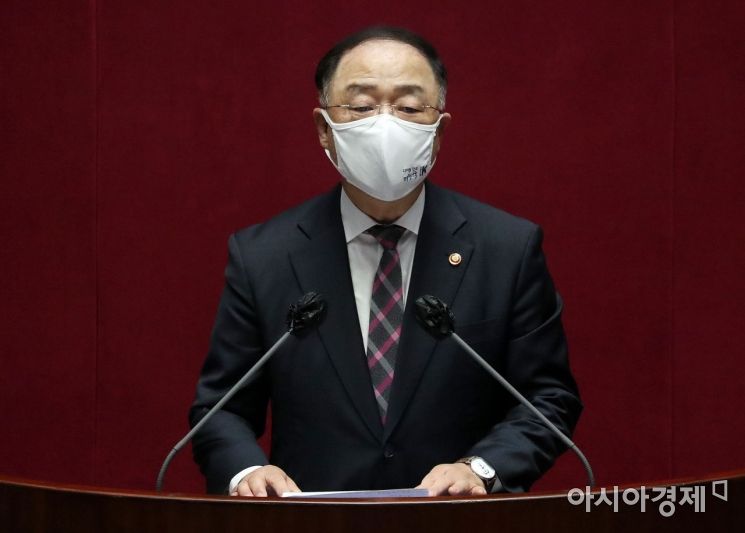 Deputy Prime Minister for Economy Hong Nam-ki is delivering the government's opinion on the supplementary budget bill worth 15 trillion won for the 4th disaster relief fund payment at the National Assembly plenary session on the 25th. Photo by Yoon Dong-ju doso7@
[Sejong=Asia Economy Reporter Kwon Haeyoung] The government has officially announced the formulation of a second supplementary budget bill, predicting additional tax revenue worth approximately 32 trillion won this year. Discussions are underway between the ruling party and the government on measures to provide tailored support to vulnerable and affected groups such as small business owners and special-type workers (teukgo), while also distributing support funds to the general public. Depending on the nature of the measures, various support payments could potentially be made as early as next month.
According to the government and the National Assembly on the 6th, the government is internally forecasting additional tax revenue of about 32 trillion won this year.
The additional tax revenue is the gap between this year’s revenue budget (283 trillion won) and the expected national tax income (315 trillion won). It is the most important indicator to gauge the scale of the second supplementary budget being pursued by the ruling party and the government. The government’s policy is to allocate the surplus tax revenue to resolving the 'K-shaped polarization' that has emerged since COVID-19.
A ruling party official explained, "The agreement between the ruling party and the government to conduct the supplementary budget within the scope of excess tax revenue without additional issuance of government bonds is a point of consensus."
National tax revenue in the first quarter of this year was 88.5 trillion won, an increase of 19 trillion won compared to a year earlier. Based on recent tax revenue conditions and annual additional tax revenue forecasts, the government and ruling party are reviewing a second supplementary budget bill worth between 20 trillion and 30 trillion won this year.
Even if the additional tax revenue is 32 trillion won, after settling 39% for local allocation tax and local education finance grants, the central government estimates that the funds available for supplementary budget formulation will be around 20 trillion won. The ruling party, however, considers the entire 32 trillion won as supplementary budget resources. Thus, the government estimates the supplementary budget resources at 20 trillion won, while the ruling party estimates 32 trillion won. There is speculation that the actual supplementary budget size will fall somewhere between these two figures.
When including support for vulnerable and affected groups such as small business owners and special-type workers, domestic demand and employment measures, and vaccine measures, the total scale of the measures could easily exceed 30 trillion won.
The government plans to announce the second supplementary budget bill when it releases the economic policy direction for the second half of the year later this month. Considering the ruling party’s timetable to pass the supplementary budget bill within July, support payments could be made as early as July.
While the overall scale of the supplementary budget and total measures has been somewhat outlined, detailed plans for domestic demand and employment measures, vaccine measures, and support for vulnerable and affected groups have yet to be finalized. In particular, there is expected to be friction between the ruling party, which insists that universal disaster relief payments are essential for domestic demand recovery, and the government, which prefers to concentrate support on vulnerable and affected groups if possible.
© The Asia Business Daily(www.asiae.co.kr). All rights reserved.

















