Blocking Tax Avoidance by Multinational Corporations with a Global Minimum Corporate Tax Rate of 15%
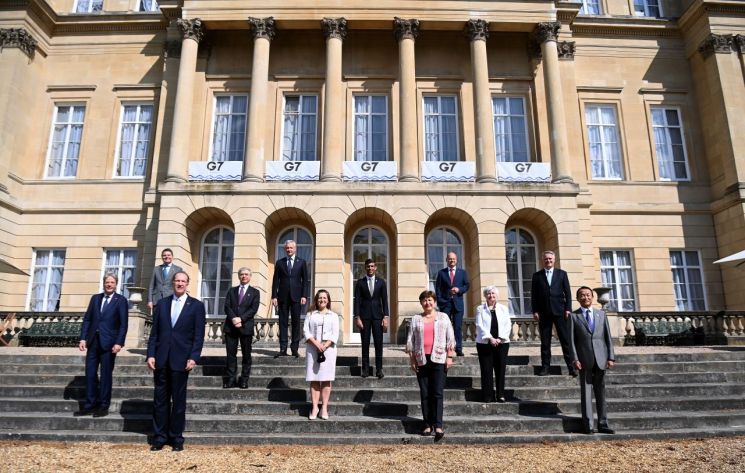
[Asia Economy Reporter Kim Suhwan] Developed countries have agreed to stop the 'race to the bottom' on corporate tax rates and to block tax avoidance by large IT companies such as Amazon, Facebook, and Google. The finance ministers of the Group of Seven (G7) evaluated this as a 'historic agreement' after years of discussions.
On the 5th (local time), the G7 finance ministers reached this agreement on the introduction of a global minimum corporate tax. In a joint statement (communiqu?), the G7 finance ministers decided to set the global minimum corporate tax rate at least 15%.
This will reduce the incentive to establish corporations in countries with low corporate tax rates, such as tax havens or Ireland, to pay less tax.
The finance ministers of these seven countries expressed expectations that tax revenues will increase, helping to replenish the empty coffers depleted by responding to the COVID-19 crisis.
They also welcomed the reform of the tax system to fit the digital age, making it impossible for multinational IT companies such as Facebook, Google, Amazon, and Apple, which earn enormous profits, to avoid paying taxes and escape.
Discussions on taxing large IT companies, mainly American firms, began in 2013 but had made no progress due to disagreements between the United States and European countries.
In response, France, the United Kingdom, Italy, and others independently created and began taxing digital services taxes.
Meanwhile, U.S. President Joe Biden recently proposed a minimum corporate tax rate of 15%, which restarted the dialogue in earnest.
The United States pressured by declaring that if the digital services tax is not abolished, it will impose retaliatory tariffs on clothing, luxury goods, and other imports from France, the United Kingdom, Italy, and others.
The joint statement also includes provisions requiring companies to pay taxes where their sales occur. Highly profitable large corporations will be taxed at a minimum of 20% on profits exceeding a 10% profit margin in the countries where they operate.
This overturns the 100-year-old international corporate tax system that taxed companies based on their location.

According to major foreign media, the G7 finance ministers wrestled over the details until the evening of the first day of the meeting.
France argued that the phrase 'at least' should be included, keeping in mind the possibility of raising the minimum corporate tax rate further.
The United States wanted the digital services tax abolished immediately, but European countries stated they would do so after the final application of this agreement.
The agreement contained in the G7 finance ministers' joint statement is expected to be finalized at the Organization for Economic Cooperation and Development (OECD) meeting in the fall after going through the Group of Twenty (G20) finance ministers' meeting next month. During this process, details such as the digital services tax and the conditions for taxable companies will need to be further refined.
Although some worry that Amazon, which has low profitability, might be excluded, U.S. Treasury Secretary Janet Yellen said at a press conference that both Facebook and Amazon will be included under any criteria, according to foreign media reports.
Secretary Yellen also evaluated this agreement, which resolved the complex negotiations that had been blocked during the Trump administration over eight years, as a historic achievement. She said it shows that multilateral cooperation can be successful.
© The Asia Business Daily(www.asiae.co.kr). All rights reserved.
![Clutching a Stolen Dior Bag, Saying "I Hate Being Poor but Real"... The Grotesque Con of a "Human Knockoff" [Slate]](https://cwcontent.asiae.co.kr/asiaresize/183/2026021902243444107_1771435474.jpg)












