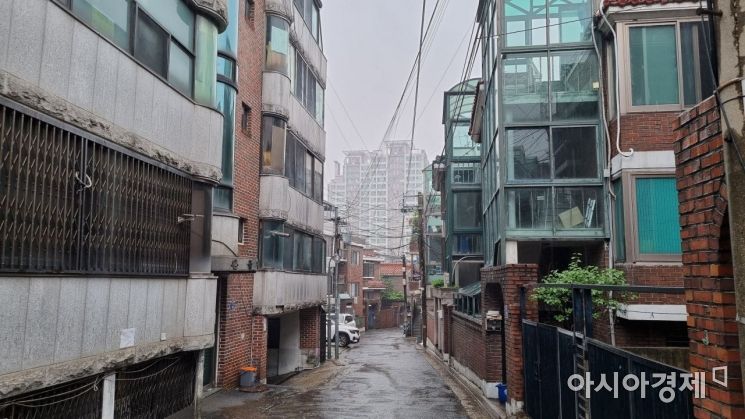
"When they told us to register as rental business operators, it was all fine, but now they say they will abolish it? I haven't raised the monthly rent for four years, and now they label me as a 'speculator' and demand I pay comprehensive real estate tax. Does that make any sense?" (Mr. A, a one-room rental business operator in Jangchung-dong, Seoul)
As the government and ruling party solidify their plan to abolish the registered rental housing system, small-scale rental business operators in university district one-room neighborhoods find themselves in a desperate situation. Although there is widespread opposition among all housing rental business operators, their expressions are darker than any other group.
Mr. A, who has lived in Jangchung-dong for 30 years and operates eight one-room units, lamented the income reduction caused by COVID-19. He had never worried about vacancies before, but this year, until February, he could not fill three rooms, causing him great distress. Eventually, he lowered the rent by 100,000 KRW and barely found tenants for two units, but one unit remains vacant.
In this situation, the news of abolishing the rental housing registration system is literally a bolt from the blue. The Democratic Party announced on the 27th, in the 'Tax Improvement Plan for Housing Market Stabilization,' that it would abolish the purchase rental housing registration system. Until now, rental business operators could receive benefits such as exemption from comprehensive real estate tax (종부세) aggregation and capital gains tax surcharges, as well as property tax reductions.
What worries Mr. A the most is the comprehensive real estate tax. He said, "I have been complying with the 5% rent increase cap and have not raised the rent for four years. But suddenly, I have become a multi-homeowner and have to pay 종부세." He added, "When I asked a real estate agency about the estimated 종부세, they said I might have to pay up to half of the annual rent as 종부세, so I have been losing sleep every night."
The situation is no different for rental business operators in other university areas. Mr. B, who operates rental business in Heukseok-dong, Dongjak-gu, is even planning to dispose of some villas. This is because the government said that if housing is disposed of within six months, capital gains tax surcharges would be exempted. However, the situation is not easy. Mr. B said, "Unlike apartments, villas are not in high demand, and due to COVID-19, there is no buying interest in university areas at all." He added, "Most people who rent villas in university areas do so for retirement income or have rental income without other income. There are no people entering to speculate on price gains like with apartments, so I don't understand why they are imposing a tax bomb here."
Researcher Heo Yoon-kyung of the Korea Research Institute for Construction Industry said, "The abolition of the rental business operator system shows the government's low understanding of the private rental market," and predicted, "It will cause long-term rent instability in the private rental housing market."
Professor Ko Jun-seok of Dongguk University Law School pointed out, "It was not multi-family or multi-unit villas that shook the real estate market," and said, "The target of the government policy is wrong." As of June last year, there were about 900,000 registered rental villa households and 360,000 apartment households. Professor Ko said, "The demand for home ownership was concentrated on apartments, not villas," and added, "Even if villa listings come to the market, there will be no buyers, and it will have no effect on stabilizing real estate market prices."
© The Asia Business Daily(www.asiae.co.kr). All rights reserved.
![Clutching a Stolen Dior Bag, Saying "I Hate Being Poor but Real"... The Grotesque Con of a "Human Knockoff" [Slate]](https://cwcontent.asiae.co.kr/asiaresize/183/2026021902243444107_1771435474.jpg)
















