CJ, US Production Plant Operating Rate at 90%
310 Billion Won Investment This Year... Triple Last Year
Nongshim Builds Large-Scale Ramen Plant 2
Daesang Prepares Localized Kimchi
[Asia Economy Reporters Hye-seon Lim and Seung-jin Lee] To cope with the changing market amid the prolonged COVID-19 pandemic, the food industry is expanding its investment in production facilities. Companies are establishing systems to respond to the continuously growing market size of K-Food overseas, while domestically focusing on securing the supply of home meal replacements (HMR), whose demand is increasing.
Full-scale Global Market Expansion
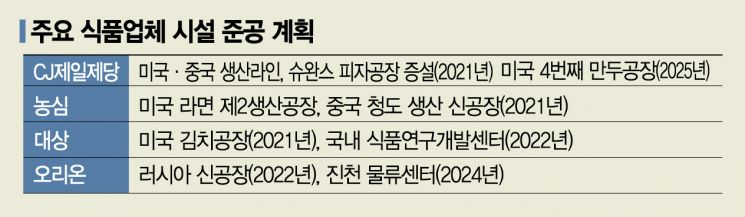
According to the food industry on the 4th, CJ CheilJedang plans to use 310 billion KRW out of its 400 billion KRW facility investment this year to expand production lines at overseas factories, more than tripling last year's amount. CJ CheilJedang is expanding dumpling production lines at its factories in the U.S. and China, as well as the Schwans pizza factory. This is to further grow the ‘Bibigo Dumplings’ business, which surpassed 1 trillion KRW in annual sales last year, and to capitalize on the frozen pizza market, which has established itself amid the non-face-to-face trend. The operating rate of the three dumpling production plants in the U.S. has already reached about 90%. CJ CheilJedang is also building the largest local dumpling factory in the U.S. Midwest, targeting completion by 2025. Earlier this year, it secured a 170,000-pyeong (approx. 561,983㎡) production site in Sioux Falls, South Dakota. CJ CheilJedang maintains stable production infrastructure across the U.S.?West (California), East (New York, New Jersey), and Midwest (South Dakota)?to prepare for mid- to long-term demand.
Nongshim and Daesang will operate their second ramen production plant and kimchi factory in the U.S. in the second half of the year. Nongshim is investing 100 billion KRW solely in production facilities this year. Due to the popularity of Korean ramen, the first U.S. plant near LA can no longer meet demand. The second plant, about 154,000㎡?three times the size of the existing U.S. factory?is under construction. This second plant is expected to serve as a foothold for Nongshim’s entry into the Latin American market. A new production plant in Qingdao, China, producing ramen soup ingredients and snack semi-finished products, will also start operations this year. Currently, over 40% of total sales come from overseas, with plans to increase the overseas sales ratio to 50% by 2030.
Daesang aims to globalize kimchi by operating a U.S. kimchi production factory within this month to produce locally customized kimchi. It is also expanding production infrastructure in China and Vietnam to establish a locally integrated business structure. Currently, it has manufacturing bases in Indonesia, Vietnam, and China. This year, Daesang plans to actively target the North American market to promote Korean kimchi.
Orion began construction in July last year on a new factory in Tver Oblast, Russia, on a 152,252㎡ (approx. 41,056 pyeong) site with a total floor area of 42,467㎡ (approx. 12,846 pyeong). The factory is scheduled for completion next year, with an investment of 80 billion KRW over three years. The factory will house six lines for Choco Pie and biscuits and two lines for snacks.
Expansion of Convenience Food Facilities Domestically
Alongside targeting overseas local markets, companies are focusing on expanding convenience food production facilities domestically. CJ CheilJedang is investing 90 billion KRW this year to expand the home meal replacement line in Jincheon and the Hetbahn factory line in Busan. Orion plans to build a logistics center with a total floor area of 38,000㎡ on an 184,502㎡ site within the Jincheon Technopolis Industrial Complex by 2024. This reflects the growing importance of logistics in delivering products quickly and accurately in an era of diversified distribution channels.
Daesang is strengthening its research and development center to lay the foundation for nurturing its global food and materials business. Daesang is constructing a food R&D center in the Magok Industrial Complex, aiming for completion in June next year, with an investment of 102.2 billion KRW. Once the Magok Research Center is completed, it plans to transfer personnel and equipment from the Icheon Central Research Center to enhance R&D capabilities. hy (Korea Yakult) is also investing 4 billion KRW this year to expand facilities, completing the expansion of the ‘hy Probiotics Plant’ in Pyeongtaek, Gyeonggi Province, next month. The number of freeze dryers will increase from four to seven.
© The Asia Business Daily(www.asiae.co.kr). All rights reserved.
![Clutching a Stolen Dior Bag, Saying "I Hate Being Poor but Real"... The Grotesque Con of a "Human Knockoff" [Slate]](https://cwcontent.asiae.co.kr/asiaresize/183/2026021902243444107_1771435474.jpg)











