Seoul City Establishes Small-scale Reconstruction Project Processing Standards
Allows Zoning Upgrades Without Mandatory Public Contributions
Only 3.4% of Eligible Small-scale Reconstruction Sites Are Underway
Free Feasibility Analysis Through Public Contest This Month
[Asia Economy Reporter Kim Hyemin] Seoul City will remove regulations to allow small-scale reconstruction projects to increase land use designation without mandatory public contributions.
On the 3rd, Seoul City announced that it has established operational standards for small-scale reconstruction projects. The city consolidated scattered procedures and standards from related laws and regulations and revised unnecessary regulations to create these standards.
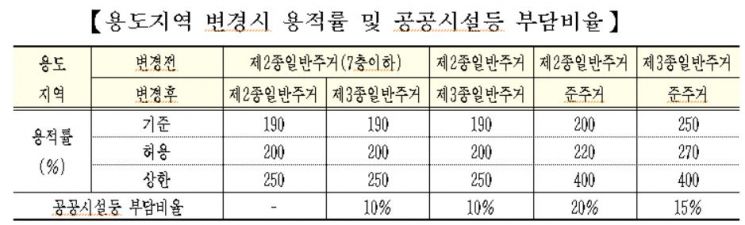
Notably, the regulation requiring mandatory public contributions for land use designation upgrades has been revised. Currently, in areas designated as Type 2 General Residential Districts with a 7-story height limit, if a small-scale reconstruction project seeks to upgrade the land use designation within the Type 2 General Residential District, a certain percentage must be contributed to the public as a mandatory condition. Although land use designation can be upgraded through integrated review if certain conditions are met, Seoul City explained that this regulation has been criticized for reducing project feasibility.
A Seoul City official stated, "Unlike large-scale redevelopment and reconstruction projects, small-scale reconstruction projects omit safety inspections and maintenance zone designations, allowing related reviews to be conducted at once through integrated review, simplifying the project procedures. However, due to factors such as floor height restrictions and lack of funding, these projects have not been activated, so we have prepared operational standards."
With the removal of mandatory public contribution regulations, the feasibility of small-scale reconstruction projects is expected to improve. If the location criteria (adjacent to Type 2 General Residential District or higher and facing a secondary road separated by pedestrian or vehicle lanes) are met, land use designation upgrades can be approved through the city's integrated review. The city predicts that about 150 complexes (23%) out of 660 complexes adjacent to Type 2 General Residential Districts with a 7-story height limit will be eligible.
Seoul City also included floor area ratio (FAR) standards that allow residents and private developers to plan up to the maximum FAR through land use designation changes and rental housing construction. For example, when upgrading the land use designation of a Type 2 General Residential District subject to a 7-story height limit to another Type 2 General Residential District, the standard FAR of 190% (allowed FAR 200%) applies. If additional rental housing is constructed, the FAR can be increased up to the maximum limit of 250%.
The new standards also include items and rates for additional allowable FAR incentives. These are aimed at achieving Seoul City's housing policy goals such as promoting eco-friendly and green buildings, allowing up to 20% FAR incentives. The 'integrated review' process, which allows building and urban management plan reviews to be conducted simultaneously, applies to cases such as land use designation changes or constructing rental housing up to the FAR limit.
Seoul City plans to hold briefing sessions so that related officials can use the newly established "Operational Standards for Small-Scale Reconstruction Projects" as guidelines, and will also post the standards on the Seoul City website. Seoul City and Seoul Housing & Communities Corporation (SH Corporation) will provide free feasibility analyses for landowners wishing to pursue projects. A call for target sites will be held within this month. Additionally, discussions will be pursued with the Korea Housing & Urban Guarantee Corporation to develop loan products for project financing.
Kim Seongbo, Head of Seoul City's Housing and Architecture Headquarters, said, "Through the standards prepared this time, residents and private developers can increase project predictability. The city will continue to establish public support foundations such as administrative and budget support to promote small-scale reconstruction projects and do its best to improve the residential environment of low-rise residential areas."
Meanwhile, small-scale reconstruction projects involve rebuilding multi-family housing on a small scale in areas with good maintenance infrastructure. Along with street housing maintenance projects and autonomous housing maintenance projects, they are subject to the "Special Act on the Maintenance of Vacant Houses and Small-scale Housing." The eligible projects must meet the following criteria: the project area is less than 10,000㎡; the number of old or poor-quality buildings accounts for two-thirds or more of all buildings in the project area; and the housing complex has fewer than 200 households.
Seoul City has identified a total of 2,070 sites eligible for small-scale reconstruction projects, but currently, projects are underway in only 70 complexes, accounting for 3.4%.
© The Asia Business Daily(www.asiae.co.kr). All rights reserved.

![Clutching a Stolen Dior Bag, Saying "I Hate Being Poor but Real"... The Grotesque Con of a "Human Knockoff" [Slate]](https://cwcontent.asiae.co.kr/asiaresize/183/2026021902243444107_1771435474.jpg)















