Increased Burden Due to End of Employment Subsidies
Limits Reached with Self-Help Efforts Alone
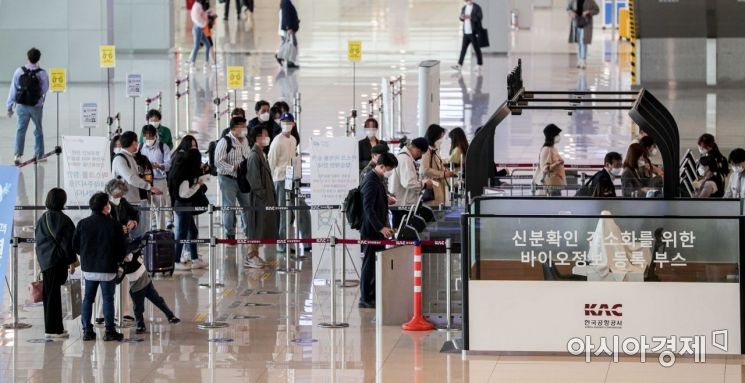 On the 11th, with 614 new COVID-19 cases reported, marking three consecutive days of over 600 cases, Seoul Gimpo Airport's domestic terminal is bustling with travelers. Photo by Jinhyung Kang aymsdream@
[Asia Economy Reporter Dongwoo Lee] As the government's paid leave employment retention support for the aviation industry ends at the end of this month, the burden on domestic low-cost carriers (LCCs) is expected to increase.
According to the aviation industry on the 3rd, Jeju Air, Jin Air, and T'way Air recently submitted unpaid leave and leave employment retention plans to the Ministry of Employment and Labor. To receive unpaid leave employment retention support (up to 1.98 million KRW per month), an application must be submitted one month prior to the leave. LCCs proactively submitted plans in preparation for the possibility that paid leave employment support will not be extended.
The industry explained in the plans that unpaid leave is inevitable to secure financial stability due to the prolonged COVID-19 pandemic and suspension of international flights. LCCs plan to collect unpaid leave applications from employees and submit them to the Ministry of Labor, with the number of unpaid leave recipients estimated to be about half of each company's total employees.
Even if employees receive leave allowances due to unpaid leave, their financial burden is expected to increase. Paid leave employment retention support provides 100% of ordinary wages or 70% of average wages. The government supports two-thirds of the leave allowances paid by companies to employees.
On the other hand, unpaid leave support is paid by the Ministry of Employment and Labor at about 50% of the average wage. Accordingly, the Korea Air Transport Association appealed for an extension of the paid leave support period, stating that there are limits to overcoming the crisis through self-help efforts alone before unpaid leave employment retention support.
In particular, the LCC industry is in urgent need of government support as management deterioration continues due to the suspension of international flight demand. In the first quarter of this year, Jeju Air recorded an operating loss of 87.3 billion KRW, Jin Air 60.1 billion KRW, T'way Air 45.4 billion KRW, and Air Busan 47.2 billion KRW, respectively.
An aviation industry official said, "It has already been over a year since we tightened our belts receiving about 70% of our usual wages, and the financial burden has reached its limit. If wages are reduced to about half from here, it will be a situation where it is difficult to endure any longer."
© The Asia Business Daily(www.asiae.co.kr). All rights reserved.

















