Declining Demand Outlook Worsens Investor Sentiment
Average 30% Drop Since Last Month
Diagnostic Kit Market Expected to Grow at 4.5% CAGR Until 2027
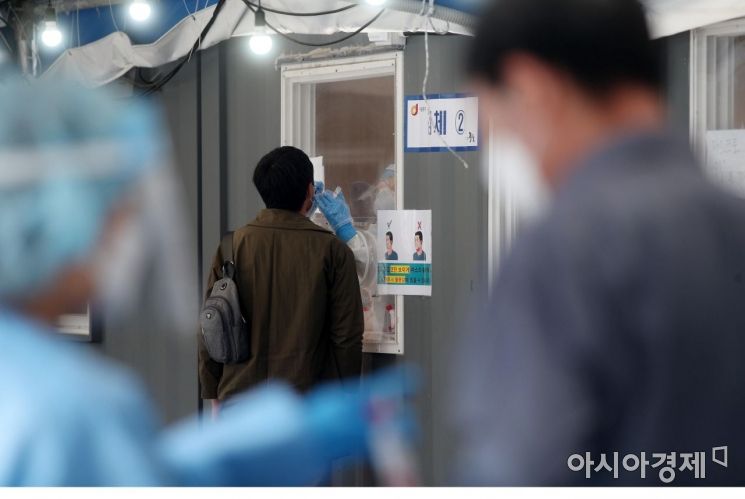 On the 31st, when the number of new COVID-19 cases recorded 430, maintaining the 400s for the second consecutive day, medical staff at the temporary screening clinic in Seoul Station Plaza are collecting samples from citizens. As of midnight that day, new cases include 411 domestic infections and 19 imported cases, bringing the total cumulative cases to 140,340 (including 9,053 imported cases). Photo by Kim Hyun-min kimhyun81@
[Asia Economy Reporter Ji-hwan Park] As the pace of COVID-19 vaccination accelerates, domestic diagnostic kit stocks are struggling. The concern that demand for diagnostic kits will decrease as vaccination rates rise has negatively affected investor sentiment.
According to the Korea Exchange on the 3rd, the stock prices of major COVID-19 diagnostic kit companies have fallen by more than 30% on average since last month. The leading company Seegene dropped 31.1% from May this year until the day before. Other diagnostic kit stocks such as Sugentech (-38.9%), LabGenomics (-6.6%), Access Bio (-44.9%), Humasis (-48.3%), and PCL (-20.1%) showed similar trends during the same period.
The recent decline in stock prices is interpreted as a sharp contraction in investment sentiment toward diagnostic kit stocks due to a decrease in new confirmed cases caused by the increase in COVID-19 vaccination rates. The expectation that future demand for diagnostic kits will decrease as vaccination rates rise is worsening investor sentiment.
In the United States, where the cumulative number of confirmed cases has reached 33.3 million, about 52% of adults aged 18 and over have been fully vaccinated against COVID-19. With the increase in vaccination rates, new confirmed cases in the U.S. have also dropped below 20,000 for the first time since the early pandemic in March last year. Compared to early January, when daily confirmed cases peaked at around 300,000, the situation has dramatically reversed. Vaccination is also accelerating domestically. According to the Korea Disease Control and Prevention Agency, as of the 1st, a total of 6.36 million people have received the first dose of the COVID-19 vaccine, showing a vaccination rate in the 12% range. The government has set a goal to complete the first dose for 36 million people, about 70% of the entire population, by September.
However, contrary to market concerns, experts do not see the future diagnostic kit market as very bleak. Global Research, a market research report specialist, forecasted that the global in vitro diagnostics market size was $83.4 billion (approximately 93 trillion KRW) last year and will grow at an average annual rate of 4.5% from this year through 2027. Regardless of the presence or absence of COVID-19 vaccines and treatments, demand for diagnostic kits is bound to expand, and especially demand from underdeveloped countries excluding major advanced countries is expected to begin in earnest now.
Ji-soo Lee, a researcher at KTB Investment & Securities, said, "The global medical market is shifting from treatment-centered to prevention and diagnosis-centered due to COVID-19," adding, "Even after COVID-19 stabilizes, diagnostic demand is expected to continue. Diagnosis has become essential for returning to daily life, and especially with the spread of variant viruses, the number of diagnostic tests is still increasing despite the decrease in confirmed cases."
© The Asia Business Daily(www.asiae.co.kr). All rights reserved.
![Clutching a Stolen Dior Bag, Saying "I Hate Being Poor but Real"... The Grotesque Con of a "Human Knockoff" [Slate]](https://cwcontent.asiae.co.kr/asiaresize/183/2026021902243444107_1771435474.jpg)
















