Index Including Owner-Occupied Housing Costs Rises for 7 Consecutive Months, Weight 243.6
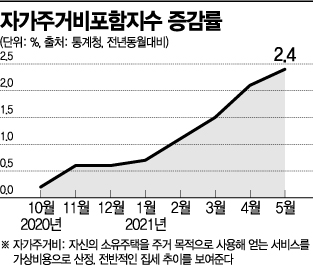
[Asia Economy Reporter Jang Sehee] The self-occupancy housing cost inclusion index, which reflects the overall trend of rent including monthly and yearly rents, has risen for seven consecutive months, leading to calls for its use as a basic indicator for reflecting inflation. The self-occupancy housing cost index is an indicator that reflects the expected rental cost that homeowners would pay if they rented a house identical to the one they own, rather than monthly or yearly rent.
According to Statistics Korea on the 3rd, last month’s self-occupancy housing cost inclusion index was 107.09 (2015=100), up 2.4% compared to the same month last year. It has risen for seven consecutive months since October 2020 (0.2%).
Currently, Statistics Korea only calculates and reflects the expenditures of households paying yearly or monthly rent in the Consumer Price Index. However, it has the limitation of not detecting expenditures of those living in owner-occupied housing. In fact, the rent component of the consumer price trend announced the previous day rose by 1.3% year-on-year, which is only about half the increase of the self-occupancy housing cost inclusion index.
Academics argue that self-occupancy housing costs should also be included to more accurately grasp inflation trends. Professor Kim Sangbong of Hansung University’s Department of Economics said, "The imputed rent method converts the concept of monthly rent into a price, but the fact that there is almost no increase in costs shows that inflation is not being properly reflected."
Statistics Korea has introduced the concept of self-occupancy housing costs but states that due to its large weighting, it is used only as a supplementary indicator.
A Statistics Korea official said, "In Korea’s housing market, the weighting value of self-occupancy housing costs is so large that it can only be used as a supplementary indicator," adding, "It is not included in the total index because it could dominate the overall consumer price index." A government official also said, "If the self-occupancy housing cost inclusion index is reflected in the overall indicator during an upward trend like now, inflation would rise," and "Conversely, during a downward phase, it would have the effect of pulling down overall inflation."
In fact, the weighting for self-occupancy housing costs is 243.6, which would be the third largest weight if included among the total 460 items. According to Statistics Korea, industrial products (333.1) have the largest weighting by item, followed by personal services (315.3), excluding dining out (188.7), and public services (142.5). The weighting by item is calculated by dividing the consumption expenditure of each item by the average monthly household consumption expenditure from the Household Trends Survey, multiplied by 1000.
© The Asia Business Daily(www.asiae.co.kr). All rights reserved.

















