[Asia Economy Reporter Park Cheol-eung] The Democratic Party of Korea is understood to be focusing on providing sufficient damage support payments rather than making the COVID-19 Loss Compensation Act retroactive. It is pointed out that calculating losses by considering past business restrictions and existing support funds does not practically help and may lead to support being concentrated in specific industries.
On the 3rd, according to some members of the Democratic Party belonging to the Small and Medium Venture Business Subcommittee of the National Assembly's Industry, Trade, and Small and Medium Venture Business Committee, discussions are focusing on whether to make the amendment to the Act on Protection and Support for Small Business Owners, proposed by party member Song Gap-seok (Chairman of the Small and Medium Venture Business Subcommittee), retroactive, with plans to decide the policy within this week.
One lawmaker said, "Floor leader Yoon Ho-jung and other leadership members are closely consulting with the Blue House and government, and the subcommittee is also setting the direction," adding, "We cannot delay any longer, so we will finalize the direction within this week."
Although several loss compensation laws have been proposed since early this year, political and government views have diverged over retroactivity, causing delays. A legislative hearing was held on the 25th of last month, and a subcommittee meeting of the Industry and Trade Committee was scheduled for the 28th but has been indefinitely postponed.
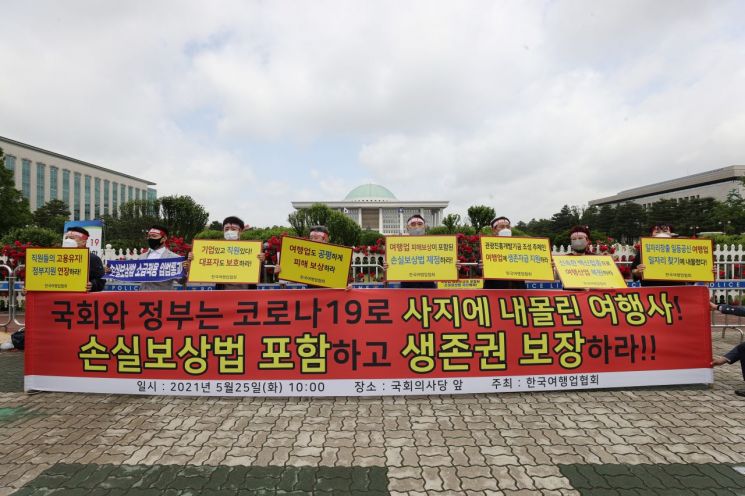
The Democratic Party is concerned about potential administrative confusion, fairness controversies, and concentration of support in certain sectors such as entertainment businesses if compensation is made retroactive to the start of last year's business restriction measures. Additionally, industries like travel, which did not face business restrictions but suffered significant damage, could fall into support blind spots. Therefore, voices suggest that it is realistic to prepare sufficient 5th disaster relief funds for uniform support by industry and to establish a legal basis for future loss compensation through law amendments.
A Democratic Party lawmaker said, "Even if the law is amended, it will inevitably take several months until enforcement, so discussions on ultra-low interest loans or damage support payments are unavoidable. The ultimate goal is to provide practical help to small business owners and self-employed people pushed to the brink, so damage support is a realistic alternative. If loss compensation is concentrated in specific industries, that also does not align with public sentiment."
Another lawmaker expressed concern, saying, "If we try to determine individual losses by considering past business restriction periods, disputes are inevitable, and there will likely be many cases that go to litigation."
Earlier, Lee Hak-young, Chairman of the Industry and Trade Committee, told Asia Economy in a phone interview, "The government continues to oppose due to administrative burdens in calculating losses and potential future disputes, so a bold disaster relief payment decided by the government and political circles could be a realistic solution." The main bill under discussion, proposed by Song Gap-seok, also stipulates that it applies only to losses occurring after the law is promulgated.
Democratic Party leader Song Young-gil said in a Q&A with reporters the day before, "Sectors like transportation, tourism, and accommodation suffer indirect damage and are not eligible for loss compensation, but they are equally suffering from COVID-19. To avoid such blind spots, combining with the 5th disaster relief fund would have a practical effect."
© The Asia Business Daily(www.asiae.co.kr). All rights reserved.

















