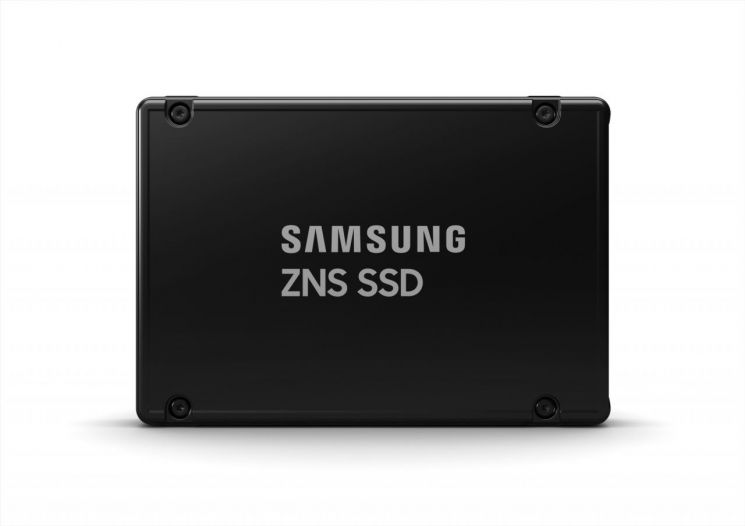
 Samsung Electronics released the 'ZNS SSD' for enterprise servers on the 2nd.
 [Photo by Samsung Electronics]
[Asia Economy Reporter Kim Heung-soon] Samsung Electronics announced on the 2nd that it will launch a solid-state drive (SSD) for enterprise servers that stores data with similar usage and cycles in the same zone. This product makes it easier to delete unnecessary information and use storage space efficiently, thereby extending the lifespan compared to existing products.
SSD is a data storage device based on NAND flash memory semiconductors that allow free data storage and deletion. Samsung Electronics applied 'ZNS (Zoned Namespace)' technology to the new SSD product. ZNS is a next-generation technology that divides the entire storage space of an SSD into small, fixed-capacity zones and stores data with similar usage and cycles in the same space to utilize storage space efficiently. It is a method of managing data by sending information with similar usage frequency among software-generated data to the same zone, like gathering beads of the same color or material in one place.
General SSDs do not divide internal storage space and arbitrarily store data generated by multiple software. It is like arranging beads with different characteristics in the order they come without any classification. Even if users try to delete unnecessary data, only the location information of the data is deleted, but the data itself remains as 'garbage,' occupying space. To solve this, a 'garbage collection' process is required, which moves necessary data to another space and deletes the garbage left in the area to secure storage space. This process causes additional 'read/write' operations on the data.
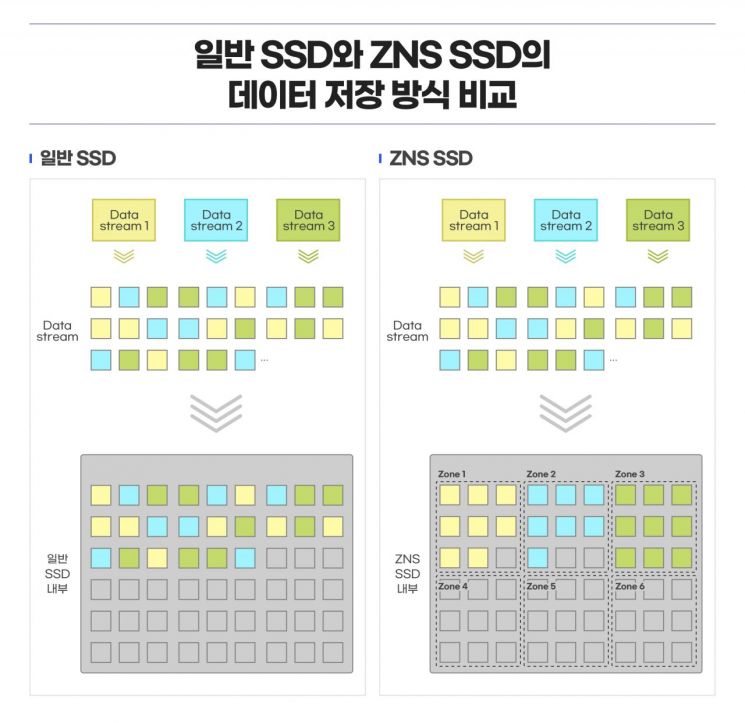 Comparison of Data Storage Methods Between General SSD and ZNS SSD
[Image provided by Samsung Electronics]
Samsung Electronics' ZNS SSD reduces such inconveniences by dividing internal storage zones. Unnecessary data can be deleted by zone, so additional 'read' or 'write' operations due to garbage collection are not needed. Because of this, Samsung Electronics explains that the product lifespan increases by up to 3 to 4 times compared to existing SSDs, which are affected by the number of operations. With the emergence of artificial intelligence (AI), big data, and the Internet of Things (IoT), data usage is rapidly increasing, and data center customers are expected to store more data on SSDs and extend product replacement cycles.
Samsung Electronics launched this ZNS SSD as a 2.5-inch product with 4TB (terabyte; 1TB=1024GB) and 2TB capacities based on 6th generation V-NAND. Full-scale mass production will begin in the second half of this year. Cho Sang-yeon, Executive Vice President of the Memory Business Division's Solution Development Office at Samsung Electronics, emphasized, "We will continue to provide next-generation memory solutions that meet the cutting-edge technology and capacity required by enterprise systems, such as applying ZNS to QLC (4 bits per cell) NAND-based SSDs in the future."
Meanwhile, according to market research firm Omdia, the global server SSD market size is expected to grow at an average annual rate of 8.7%, from $17.239 billion (about 19 trillion KRW) last year to $26.187 billion (about 29 trillion KRW) by 2025. Samsung Electronics maintained the No. 1 position with a 35.5% market share in the overall SSD market as of the fourth quarter of last year. Especially in the server market, where high performance and reliability are required, the market share exceeds 40%.
© The Asia Business Daily(www.asiae.co.kr). All rights reserved.
![Clutching a Stolen Dior Bag, Saying "I Hate Being Poor but Real"... The Grotesque Con of a "Human Knockoff" [Slate]](https://cwcontent.asiae.co.kr/asiaresize/183/2026021902243444107_1771435474.jpg)

















