 Photo description
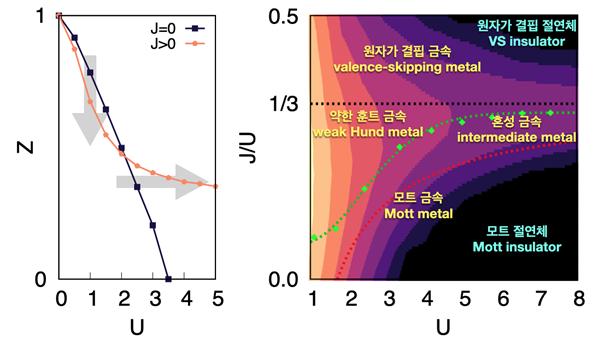
 Figure 1. (Left) A diagram showing the change pattern of metal properties with increasing Hund interaction. The graph (orange) when the Hund factor (J) has a finite value starts smaller than the graph (black) representing zero and gradually reverses in size. From the perspective of the traditional indicators of electron interaction Z (y-axis) and U (x-axis), this shows a peculiar situation where the strength cannot be said to increase or decrease. Scholars often call this unusual phenomenon the "Janus effect," named after the Roman god, which is a prominent feature of Hund metals. In this study, this Janus effect was demonstrated at the orbital quantum number '2'. (Right) Shows the newly proposed phase diagram in this study. It can be seen that a weak Hund metal state exists even at the orbital quantum number '2', and various other peculiar metallic and insulating phases (indicated by the black area) around it are distinguished. Figure and description provided by KAIST.
[Asia Economy Reporter Kim Bong-su] Unlike conventional metals, Korean researchers have demonstrated the possible existence of 'Hund metal,' a distinct state where electric current flows without electrical resistance.
The Korea Advanced Institute of Science and Technology (KAIST) announced on the 1st that Professor Han Myung-jun's research team in the Department of Physics has, for the first time, proven the possible existence of a unique quantum state known as 'Hund metal.' Hund metals exhibit superconductivity, where current flows without electrical resistance, or show significant changes in material properties even with slight external condition variations, making them next-generation novel materials with potential applications beyond traditional semiconductor materials. The term refers to metals exhibiting a unique quantum mechanical state named after the German physicist Friedrich Hermann Hund, well known for 'Hund’s rule.'
In academia, typical metals are generally called 'Fermi liquid metals,' and understanding metals with distinctly different properties has long been a significant focus. Research on such unusual metals is believed to provide clues to understanding major physics mysteries such as high-temperature superconductivity and quantum critical phenomena. Hund metals are among these. Since the concept was first proposed by American theoretical physicists, active research has been conducted over the past decade, led by scholars from the United States and Europe.
Specifically, this metallic state has mainly been studied when the number of 'orbitals'?quantum mechanical states that electrons can occupy within an atom?is '3' or more, and it was commonly accepted that Hund metals could not appear when the number is '2.'
This study overturns that conventional wisdom by theoretically proving that Hund metals can manifest even when the number of orbitals is '2.' The research team named this state 'weak Hund metal,' noting that its signals are weaker than those of conventional Hund metals. They also proposed new criteria for understanding and classifying Hund metals and related states.
Particularly, this may provide a breakthrough in understanding the mysteries of nickel-based compound superconductors, discovered in 2019 and extensively studied but still facing theoretical challenges. Various theories have been proposed based on the multi-orbital characteristics of these superconductors, and this study offers a new perspective by viewing the material through the lens of the weak Hund metal state.
Professor Han Myung-jun explained the significance of the research, saying, “The results are so groundbreaking that even the reviewers of the paper initially found them difficult to accept. This foundational theoretical research establishes a new framework for understanding related experimental data and phenomena, and it is expected to serve as a basis for solving several superconductivity-related problems that the academic community has struggled with until recently.”
The research findings were published online on the 17th of last month in the world-renowned physics journal Physical Review Letters.
Below are explanations of key terms.
▲ Hund’s rule
= A simple set of laws explaining how multiple electrons exist within an atom while satisfying quantum mechanical rules, proposed around 1927 by the German physicist Friedrich Hund.
▲ High critical temperature superconductivity
= Refers to superconductivity with a critical temperature much higher than usual. Many causes of this superconductivity cannot be explained by traditional theories, so it is understood as unconventional superconductivity.
▲ Quantum critical phenomena
= Unlike ordinary phase transitions caused by thermal fluctuations depending on temperature, these are phase transitions and related quantum phenomena induced by quantum mechanical fluctuations near the transition point.
© The Asia Business Daily(www.asiae.co.kr). All rights reserved.
!["The Woman Who Threw Herself into the Water Clutching a Stolen Dior Bag"...A Grotesque Success Story That Shakes the Korean Psyche [Slate]](https://cwcontent.asiae.co.kr/asiaresize/183/2026021902243444107_1771435474.jpg)
















