GIST Professor Jeon Chang-deok's Team "Will Devise New Immunotherapy Strategies"
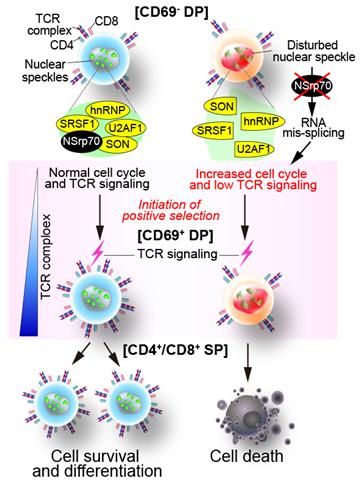 Schematic diagram of the abnormal development mechanism of T lymphocytes deficient in NSrp70 protein. Image provided by GIST.
 In T lymphocytes lacking NSrp70, numerous gene regulatory factors affected by the alternative splicing of NSrp70 fail to perform their original functions. As a result, increased cell proliferation and reduced T cell receptor signaling capacity lead to abnormal developmental processes, and T lymphocytes in experimental mice deficient in NSrp70 protein undergo apoptosis and disappear.
[Asia Economy Reporter Kim Bong-su] A key factor regulating the development of 'T lymphocytes,' immune cells within the human body that attack viruses and cancer cells, has been discovered by a domestic research team.
The research team led by Professor Chang-Deok Jeon of the Department of Life Sciences at Gwangju Institute of Science and Technology (GIST) announced on the 1st that they discovered a new key factor regulating the development of T lymphocytes, which attack and eliminate virus-infected cells and cancer cells, called 'NSrp70 (Nuclear Speckle-related protein 70),' and elucidated its mechanism of action.
T lymphocytes are immune cells that play a very important role in immune responses, accounting for more than 70% of all lymphocytes, and have recently attracted attention as a key research subject in gene therapy and cell therapy. In particular, T lymphocytes play a decisive role in killing cells infected with viruses such as COVID-19, making them a key factor in the success or failure of vaccines.
The research team revealed for the first time in the world through genomic analysis of T lymphocytes deficient in NSrp70 that multiple gene regulatory proteins were altered due to the selective splicing function of NSrp70. They also confirmed that when NSrp70 is deficient, T lymphocytes fail to mature normally in the thymus and die, leading to lymphocytopenia, which results in the loss of the immune system’s anti-cancer and antiviral capabilities.
NSrp70 is a 70 kDa protein found in the form of speckles within the cell nucleus, first discovered by the research team, and its name means ‘nuclear speckling protein.’ It was registered with the NCBI (National Center for Biotechnology Information) in 2011. NSrp70 performs the function of producing more diverse proteins than the number of genes through alternative splicing during protein synthesis from genes.
Professor Chang-Deok Jeon said, "We have identified a new key gene regulating the development of T lymphocytes, which we hope will become a new milestone in unraveling the secrets of the birth and death of immune cells," and added, "Future follow-up research plans to establish new immunotherapy strategies that promote the growth of T lymphocytes capable of suppressing cancer proliferation or responding to specific viruses by using gene therapy targeting NSrp70."
The results of this study were published online on the 25th of last month in ‘Nucleic Acids Research,’ a journal ranked in the top 5% in the fields of biochemistry and genetics.
© The Asia Business Daily(www.asiae.co.kr). All rights reserved.

















