Seoul 59-Year-Old Restaurant Raises Prices by 1,000 Won Again This Year
Rising Prices of Rice, Beans, and Grains... Grocery Basket Inflation Alert
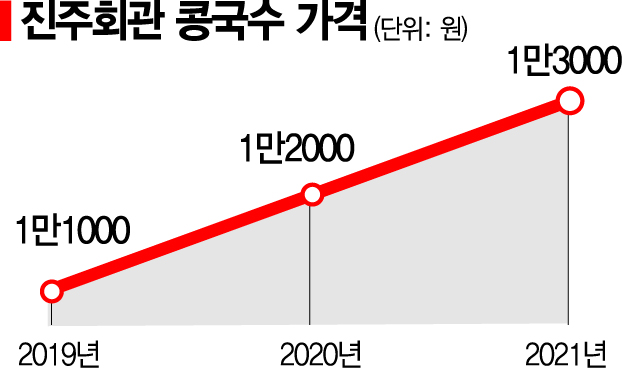
[Asia Economy Reporter Lim Chun-han] "They raised the price by 1,000 won last year, and now they've raised it again. Now it's 13,000 won per bowl." Customers eating Kongguksu at Jinju Hoegwan in Jung-gu, Seoul, speak loudly after ordering. Although they are talking among themselves, it is clearly meant to be heard. The serving staff, perhaps feeling awkward, brings the Kongguksu and says, "Prices of agricultural products like beans and cabbage have risen so much that we can't avoid annual price increases." Although this is said to another table, it is clearly a response to those who just complained about the high price.
Since opening in 1962, Jinju Hoegwan, famous for its Kongguksu, has raised its price by 1,000 won again this year following last year. The price has sharply increased from 11,000 won in 2019 to 12,000 won in 2020, and now to 13,000 won this year. A Mr. A, who dined at Jinju Hoegwan on the weekend of the 31st, said, "The price of Pyongyang cold noodles has been rising sharply for years, usually around 13,000 won and sometimes up to 14,000 won, so seeing Kongguksu reach 13,000 won makes me think Pyongyang cold noodles prices will rise again soon. These days, prices for everything are going up, so it's scary to buy food outside."
Famous cold noodle restaurants are also showing signs of change. Bongpiyang and Uraeok, which raised prices to 14,000 won two years ago, did not increase prices last year, and Nampo Myeonok, Eulji Myeonok, and Eulmildae also kept prices at 12,000 won. Despite sharp increases in major ingredients such as beef, rice, beans, and buckwheat last year, restaurants refrained from raising prices due to the burden it would place on consumers amid the COVID-19 pandemic.
However, the situation has changed this year. With Jinju Hoegwan raising the price of Kongguksu, Pyongyang cold noodle restaurants have gained justification to raise their prices as well. Recently, grain prices have continued to rise, and prices of major ingredients such as rice, beans, and buckwheat have yet to stabilize. Additionally, although the Bank of Korea kept the base interest rate unchanged, it mentioned inflationary effects due to rising major raw material prices, so it is expected that major restaurants that froze prices last year will raise prices simultaneously.
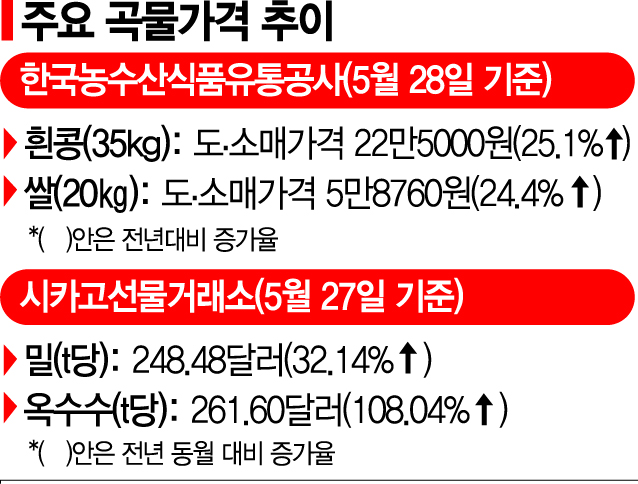
According to the Korea Agro-Fisheries & Food Trade Corporation (aT) on the 31st, the wholesale and retail price of 35kg of domestic white beans was 225,000 won as of the 28th. This is 25.1% higher than 176,000 won a year ago and 26.9% higher than the average price of 175,333 won. The wholesale and retail price of 20kg of rice was 58,760 won, up 24.4% from last year and 38.2% from the average.
International wheat and corn prices are also continuing their sharp rise. According to the Chicago Mercantile Exchange, the price of wheat per ton was $248.48 as of the 27th, up 32.14% year-on-year, and corn was $261.60, up 108.04% year-on-year. The Korea Rural Economic Institute stated in its international grain outlook that the international grain futures price index for the second quarter of this year is expected to rise 4.3% from the previous quarter to 143.6. The grain import unit price index for the second quarter, which forecasts domestic import prices, is expected to rise 8.5% quarter-on-quarter for edible grains.
In fact, price increases are materializing in the food industry. CJ CheilJedang raised prices of Hetbahn (cooked rice) by 7%, tofu by 11.6%, and bean sprouts by 9.9% earlier this year. CJ CheilJedang stated it has no plans to raise flour prices for the time being but is under pressure due to the continued rise in international wheat prices. SPC Group's Paris Baguette raised prices on 95 items, about 14.4% of its 660 products, and SPC Samlip raised prices on about 30 types of mass-produced bread by 9%. CJ Foodville's Tous Les Jours also raised prices on about 90 types of bread by an average of 9%.
Dining-out prices are also rising sharply. In particular, prices of popular items like gimbap and jajangmyeon have all increased. According to Statistics Korea, the dining-out price index in April was 113.02, up 1.9% year-on-year. This is the highest increase in 22 months since June 2019. The dining-out price increase rate had been maintained at 0.5?1.0% last year but rose to 1.1% in January, 1.3% in February, and 1.5% in March. Jajangmyeon prices rose 3.2%, the highest since October 2019, and gimbap prices rose 4.4%, the largest increase since November 2019.
© The Asia Business Daily(www.asiae.co.kr). All rights reserved.


















