Gas Station Association Urges Improvement of Unfair Discount Policies at Press Conference
"Korea National Oil Corporation's Dominant Position Causes Unfair Market Intervention and Hinders Fair Competition"
Supply Price Gap Exceeds 100 Won per Liter Due to COVID-19
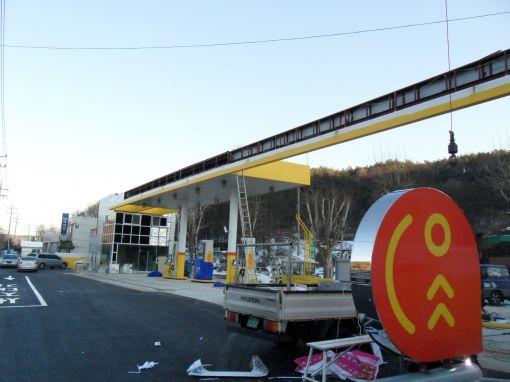 A gas station in Gyeonggi-do undergoing renovation as a budget-friendly gas station
[Asia Economy Reporter Choi Dae-yeol] As the fuel supply contract for budget gas stations is about to expire, the regular gas station industry has raised its voice, demanding an end to "unfair discriminatory policies." They claim that Korea National Oil Corporation (KNOC) is interfering in the gas station market and harming fair competition, and have stated that they will take collective action if the current situation is not improved.
The Korea Gas Station Association held a press conference in front of the National Assembly on the 28th, arguing that "the government is unfairly intervening in the gas station market by abusing the dominant position of the public enterprise Korea National Oil Corporation, discriminating in supply prices, and hindering fair market competition," and called for a revision of the current budget gas station policy. They warned that if the government or the National Assembly does not come up with measures, they may enter a collective shutdown, citing the worsening business environment for gas stations due to the current budget policy.
KNOC signs contracts with refiners every two years to secure petroleum products to supply to budget gas stations. The contract signed in 2019 will expire this August. They are currently negotiating whether to extend the contract by one year with existing suppliers such as SK Energy and S-Oil or to end the contract and prepare for a new bidding process. The decision on contract extension is expected to be made within this month.
The main grievance of the regular gas station industry is that KNOC procures supplies at prices set by lowest-price bidding, which are excessively lower than market prices. As a result, refiners compensate for losses by selling the same products at higher prices to regular gas stations. Although supplying budget gas stations is not profitable for refiners, it is a government project carried out by KNOC, and since it guarantees a certain level of demand, refiners cannot simply withdraw.
The Gas Station Association claims that the price gap between budget and regular gas stations has widened further due to the ongoing COVID-19 pandemic since last year. The association explained, "As international petroleum product prices plummeted due to COVID-19, domestic refiners reduced factory operations and raised supply prices to gas stations. KNOC, however, receives petroleum products from refiners based on international product prices according to contracts, supplying budget gas stations at prices more than 100 KRW per liter lower than regular gas stations."
Budget gas stations, now in their 10th year, have steadily increased and account for just over 10% of all gas stations. While they encourage price competition and enhance consumer utility, there have been considerable side effects, such as the closure of many existing regular gas stations. Considering that public funds are used to convert stations into budget gas stations, there are criticisms that the actual cost-effectiveness is not significant.
Yoo Ki-jun, president of the Gas Station Association, stated, "Regular gas station operators, who suffer from the government's unfair discriminatory policies, resent the government and find it difficult to accept the policy," and urged, "Please stop KNOC's unfair market intervention and discriminatory policies that give preferential treatment to only some budget gas stations using taxpayers' money." He added, "If the government truly wants to supply fuel to the public at affordable prices, it should not give preferential treatment to only some budget gas stations but convert all gas stations into budget gas stations and supply fairly."
© The Asia Business Daily(www.asiae.co.kr). All rights reserved.
















