Bank of Korea sharply raises growth forecast from 3.0% to 4.0%... Positive outlook for Korean economy recovery
Base rate held steady but possibility of hike within the year increases
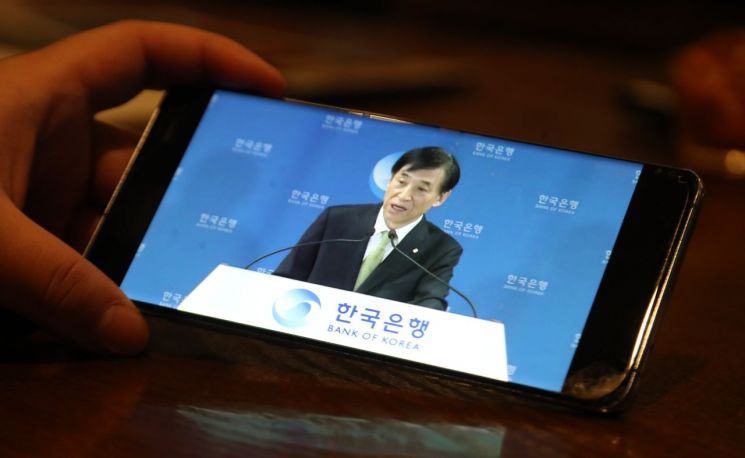
[Asia Economy Reporters Eunbyeol Kim, Sehee Jang] The Bank of Korea has significantly raised its economic growth forecast for this year to 4.0%. This is a 1.0 percentage point increase from the previous forecast of 3.0%. However, the base interest rate was maintained at a record low of 0.50% per annum.
On the 27th, the Bank of Korea projected that the Korean economy will grow by 4.0% this year. In February, the Bank had maintained its growth forecast at 3.0%, but it has now been substantially revised upward. This is attributed to the accelerated pace of global economic recovery, strong export performance, and the anticipated impact of large-scale fiscal policies going forward.
According to the Korea Customs Service, export value from the beginning of this month to the 20th reached $31.12 billion, marking a 53.3% increase compared to the same period last year. Not only exports but also private consumption in the first quarter showed signs of recovery. Private consumption increased by 1.1% quarter-on-quarter, driven mainly by durable goods such as passenger cars and home appliances, as well as non-durable goods like food and beverages.
The Bank of Korea had forecasted a 3.0% growth rate on February 25, and reflecting the accelerated growth pace since then, Governor Lee Ju-yeol expressed his intention to revise the forecast upward. Governor Lee stated, "An annual growth rate in the mid-3% range is certainly possible this year." While the market had expected a growth forecast in the high 3% range, the Bank's projection is even higher.
If the Bank's forecast of 4.0% growth is realized, Korea's annual growth rate will be the highest since 2010 (6.8%). In 2010, growth surged rapidly as the country quickly recovered from the global financial crisis.
However, uncertainty remains due to the slow recovery in the employment market. The number of employed persons in April was 27.214 million, an increase of 652,000 compared to a year earlier, marking the largest increase in 6 years and 8 months since August 2014. However, employment among those in their 30s and 40s decreased by 98,000 and 12,000 respectively. The youth unemployment rate has also remained in the 10% range for three consecutive months since February.
The Bank of Korea forecasted next year's growth rate at 3.0%, and consumer price inflation at 1.8% this year and 1.4% next year. With the faster pace of economic recovery, the inflation forecast was raised by 0.5 percentage points from the previous 1.3%. The inflation forecast is now approaching the Bank's price stability target of 2.0%.
However, despite raising growth and inflation forecasts, the Monetary Policy Committee of the Bank of Korea kept the base interest rate unchanged at 0.50% per annum. Although the domestic economy is showing signs of recovery in exports and investment, factors such as ongoing social distancing measures causing uneven recovery across industries, low vaccination rates, and COVID-19 variants could constrain growth.
With the upward revision of growth and inflation forecasts, the possibility of an interest rate hike within the year has increased. The Bank of Korea has four opportunities to decide on rates this year (July, August, October, November), and currently, the November hike is considered most likely as herd immunity through vaccination appears achievable by then. Some speculate that if vaccination progresses faster than expected and the economy overheats, a rate hike could occur as early as the third quarter.
Professor Jinil Kim of Korea University’s Department of Economics suggested that Korea might preemptively raise the base rate ahead of the U.S. depending on circumstances. Professor Kim said, "Governor Lee Ju-yeol’s term ends at the end of March next year, and he may want to raise rates at least once before finishing his term. If a preemptive rate hike occurs, it could happen once at the end of this year or early next year."
Professor Inho Lee of Seoul National University’s Department of Economics stated, "It seems the U.S. will not take long to discuss tapering (asset purchase reduction). The U.S. Federal Reserve (Fed) is also expected to raise rates in the second half of the year considering economic overheating." He added, "If the Fed raises rates around the third quarter, Korea will likely follow by the third or fourth quarter at the latest."
There are also opinions that while rates should be raised in line with economic recovery, rapid hikes could cause side effects. Professor Soyoung Kim of Seoul National University’s Department of Economics said, "While rate cuts are usually made preemptively, rate hikes tend to be reactive. Interest rates should be adjusted in small increments to avoid sudden money movement phenomena."
Meanwhile, major global financial institutions and domestic and international economic research institutes have already revised Korea’s economic growth forecasts upward. The Korea Institute of Finance projected 4.1%, the Capital Market Institute 4.3%, and LG Economic Research Institute 4.0%, with several institutions forecasting growth above 4%. The U.S. investment bank JP Morgan predicted 4.6%. Earlier, President Moon Jae-in also stated a goal of 4% growth for this year.
© The Asia Business Daily(www.asiae.co.kr). All rights reserved.

















