Research Team Led by Lee Chang-jun at Institute for Basic Science Collaborates with Domestic and International Researchers to Uncover Mechanism
[Asia Economy Reporter Kim Bong-su] A new gene causing hearing loss has been discovered through joint research by domestic and international scientists.
The Institute for Basic Science (IBS) announced on the 25th that the research team led by Director Chang-Jun Lee of the Cognitive and Sociality Research Center, in collaboration with Professor Byung-Yoon Choi's otolaryngology team at Bundang Seoul National University Hospital, Mokpo National University, Central South University in China, and the University of Miami in the United States, identified a new hearing loss gene, TMEM43 mutation, and elucidated the mechanism by which it causes auditory neuropathy. This is expected to contribute to the diagnosis and treatment of hearing loss.
‘Auditory Neuropathy Spectrum Disorder (ANSD)’ is a hearing disorder characterized by abnormalities in the cochlea or auditory nerve, where sound perception is possible but the ability to distinguish speech (speech discrimination) is impaired. Treatment methods and outcomes for hearing loss depend on the pathological cause, but auditory neuropathy is very difficult to treat due to its diverse causes and manifestations.
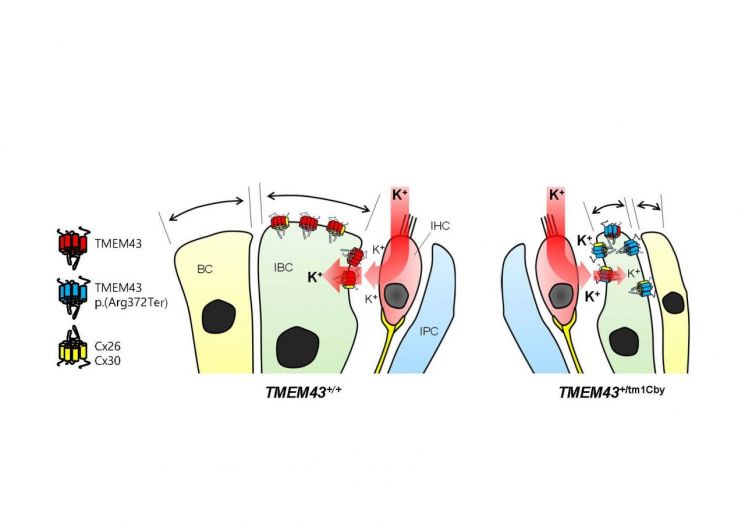
One cause of hearing loss is the dysfunction of ‘gap junctions’ due to abnormalities in cochlear supporting cells (GLS). However, the types of hearing loss genes involved and the mechanisms of progressive hearing loss onset have been largely unknown. The joint research team identified a new hearing loss gene, TMEM43, present in cochlear supporting cells through genetic testing and revealed its pathological mechanism for the first time worldwide.
The research team first analyzed the pedigrees of Korean and Chinese patients with progressive auditory neuropathy to find the cause of hearing loss. Genetic testing confirmed that the TMEM43 mutation was commonly inherited, indicating that the TMEM43 gene is the cause of hearing loss.
This was also confirmed through experiments on mouse models injected with the TMEM43 mutant gene. While normal mice showed growth in cochlear supporting cells as they matured, mutant mice did not. The TMEM43 mutation causes abnormalities in cochlear supporting cells. Analysis confirmed that the TMEM43 protein regulates gap junction function and plays a key role in maintaining homeostasis within the cochlea. In other words, defects in the TMEM43 protein within cochlear supporting cells lead to abnormal gap junction function, causing auditory neuropathy.
Based on the experimental results, the research team performed cochlear implant surgery, which replaces cochlear function, on three hearing loss patients with abnormalities in the TMEM43 protein. As a result, their speech discrimination ability was successfully restored. This provided a precise treatment indicator, cochlear implantation, for cases where the TMEM43 mutation is the cause of hearing loss.
Professor Byung-Yoon Choi of Bundang Seoul National University Hospital said, “By discovering a new hearing loss gene and revealing its pathological mechanism, we expect to greatly contribute to the diagnosis and treatment of hearing loss,” adding, “This is a good example of precision medicine that will be a great help to adult auditory neuropathy patients for whom it was difficult to decide on early cochlear implantation.”
Director Chang-Jun Lee of the Institute for Basic Science stated, “This achievement was the result of collaboration between clinical doctors and basic scientists worldwide, with Korean scientists leading the research,” and added, “It is significant in that it elucidated the molecular physiological role of glial cells within the peripheral nervous system cochlea, an area that has been somewhat under-researched.”
The research results were published online on the 25th at 4 a.m. (Korean time) in the international journal Proceedings of the National Academy of Sciences (PNAS, IF 9.412).
© The Asia Business Daily(www.asiae.co.kr). All rights reserved.

















