[Asia Economy Reporter Eunmo Koo] The Korea Internet & Security Agency (KISA) is taking steps to establish a strengthened cybersecurity response system through upgrades to the ‘Cyber Threat Analysis and Sharing (C-TAS)’ system and other measures.
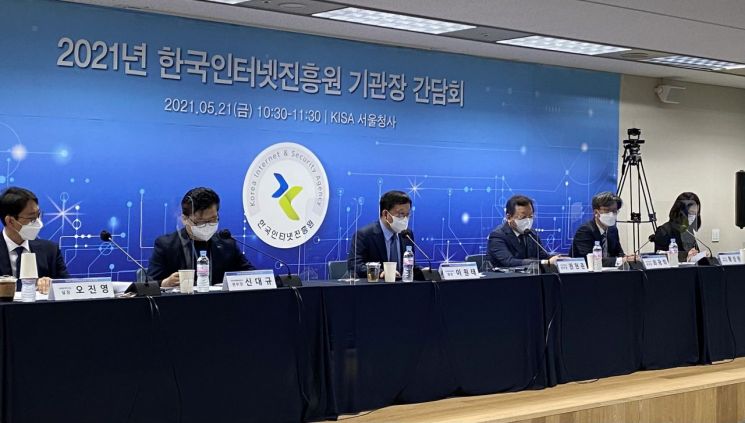
At a press briefing held on the 21st at KISA’s Seoul headquarters in Songpa-gu under the theme ‘Digital Transformation and the Future of KISA,’ KISA President Won-Tae Lee announced plans to build a comprehensive response system covering the entire cycle from preemptive blocking of cyber threats to prevention, detection, response, and recovery during his term.
Previously, a reactive approach was taken using traditional intrusion response technologies to detect and respond after incidents occurred. Going forward, KISA aims to model an intelligent threat response system utilizing information and communication technologies (ICT) such as artificial intelligence (AI) and big data, thereby strengthening what is called a ‘digital threat immune system.’
He also introduced a new security model called ‘Hyper Security+X.’ President Lee described it as a “super-security concept responding to the paradigm shift in information protection,” adding, “We will strive to create and concretize a model equipped with ‘cyber immunity’ through the internalization of information protection, ‘cyber resilience’ to rapidly recover from damage, and ‘cyber foresight’ to predict attacks in advance using new technologies such as AI.”
He presented concrete plans to build a digital immune system with resilience and recovery capabilities against various cyber threats. First, he pledged to strengthen security for non-face-to-face services that have increased since COVID-19. President Lee explained, “We will meticulously establish security systems for key services in the transition to a contactless society, such as the ‘My PC Care Service,’ which provides real-time remote security diagnostics for all citizens’ PCs and Internet of Things (IoT) devices.” He added, “We will also enhance mobile security by collaborating with telecom companies to diagnose security vulnerabilities in mobile apps and support rapid guidance, notification, and improvement measures for app operators and users.”
President Lee continued, “In the event of a breach, we will establish a system that collects, analyzes, and shares vast cyber threat information across various fields using AI and data.” KISA plans to significantly expand the scope and scale of security threat information collection within this year to build big data on sector-specific threat information, and by next year, it aims to advance security threat analysis using intelligent technologies and develop an intelligent security framework.
He also emphasized plans to improve the C-TAS system for sharing cyber threat information so that it can operate on a public-private cooperation basis. To this end, KISA plans to build and operate a ‘Cybersecurity Alliance’ in partnership with major private companies. President Lee said, “This can be seen as an expanded version of the existing C-TAS,” explaining, “It will broaden the scope of cyber threat information sharing to include over 60 private companies, including Internet Data Centers (IDCs), and the nature of the information will change significantly, allowing sharing of threat information derived from big data analysis rather than just comprehensive past threat information.”
He also expressed intentions to advance the workforce and talent development system in the fields of personal information protection and digital trust. President Lee stated, “Expanding specialized universities for information protection and graduate schools for convergence security, and conducting on-the-job training to strengthen practical security capabilities are representative examples,” adding, “We will also prepare various innovative programs for talent development.”
Additionally, the nationwide digital safety net will be reinforced. President Lee said, “We will further strengthen the foundation of digital trust by building a more detailed digital social safety net nationwide,” and added, “To eliminate security blind spots such as regional small and medium-sized enterprises, we will expand the response system, which has been centered on the metropolitan area, to a nationwide scale.”
© The Asia Business Daily(www.asiae.co.kr). All rights reserved.

















