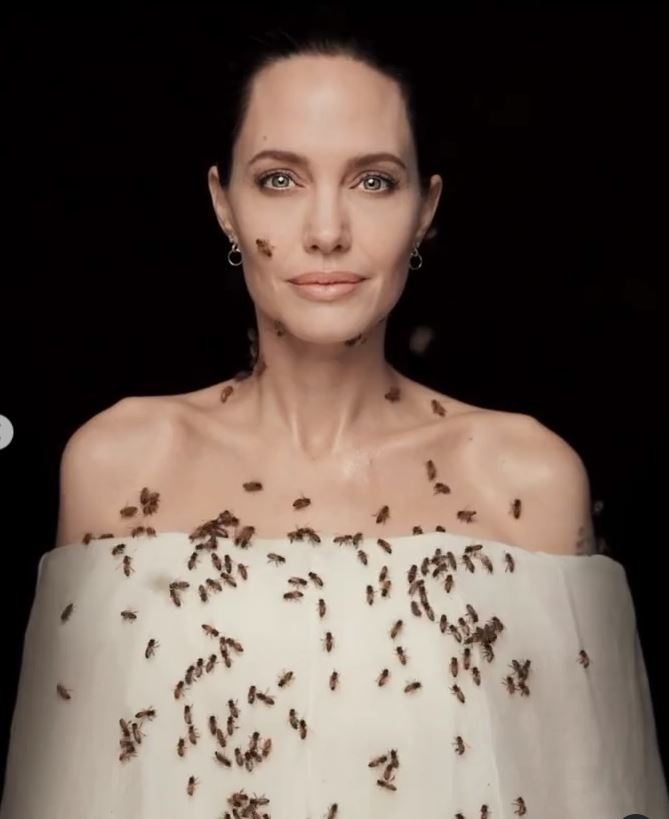
 On the 20th (local time), a photo shoot featuring Angelina Jolie with dozens of bees was released on the National Geographic website.
 [Photo by National Geographic]
[Asia Economy Reporter Hwang Sumi] Hollywood actress Angelina Jolie has attracted attention with a photo shoot featuring dozens of bees. Even as the bees crawled over her upper body, she remained calm and posed steadily.
On the 20th (local time), National Geographic released photos and an interview video of Jolie with the bees on its website. This project was conducted to raise public awareness for bee protection, which benefits the ecosystem, in celebration of the United Nations-designated "World Bee Day."
Jolie applied "pheromones" all over her body to attract the bees and participated in the shoot without wearing protective clothing. She maintained focus and posed for 18 minutes even as the bees crawled over her upper body. She remained composed even when a bee crawled under her dress and climbed onto her thigh. Dan Winters, an amateur beekeeper and the photographer in charge of the project, said, "Jolie never flinched once," adding, "It was as if she had been doing this all her life, and I was deeply impressed."
In the interview, Jolie emphasized the importance of bees, saying, "Protecting the pollinators that sustain life is our responsibility." She also stated, "Beekeeping is essential for improving environmental, agricultural, and food issues," and noted that utilizing beekeeping techniques could benefit local communities.
She introduced the "Women Beekeepers Training Program," a collaboration between UNESCO and the French cosmetics company Guerlain. The program aims to create 2,500 beehives within UNESCO biosphere reserves by 2025, increasing the bee population to 125 million. Guerlain reportedly donated $2 million to support the training of 50 female beekeepers and entrepreneurs in 25 biosphere reserves worldwide designated by UNESCO.
Meanwhile, according to the United Nations Food and Agriculture Organization (FAO), bees are responsible for pollinating about 70% of the top 100 crops that account for 90% of the world's food. In addition, bees pollinate crops used for fruits, nuts, vegetables, as well as those used in clothing and pharmaceuticals. Furthermore, the presence of bees, which are highly sensitive to their environment, serves as an environmental indicator species showing the health of the local natural ecosystem.
However, over the past decade, the global honeybee population has noticeably declined due to factors such as excessive use of chemical products including pesticides and the reduction of native habitats caused by large-scale commercial monoculture. Recently, the impact of COVID-19 has raised concerns about difficulties in crop production dependent on bee pollination, bringing increased attention to bee health and the preservation of their ecosystems.
© The Asia Business Daily(www.asiae.co.kr). All rights reserved.

















