Expected IPOs up to 200 Trillion Won in the Second Half of This Year
Stock Supply Expansion Exceeding 2-3% of KOSPI Market Cap
Acts as a Dampener on the Stock Market Trend in the Second Half
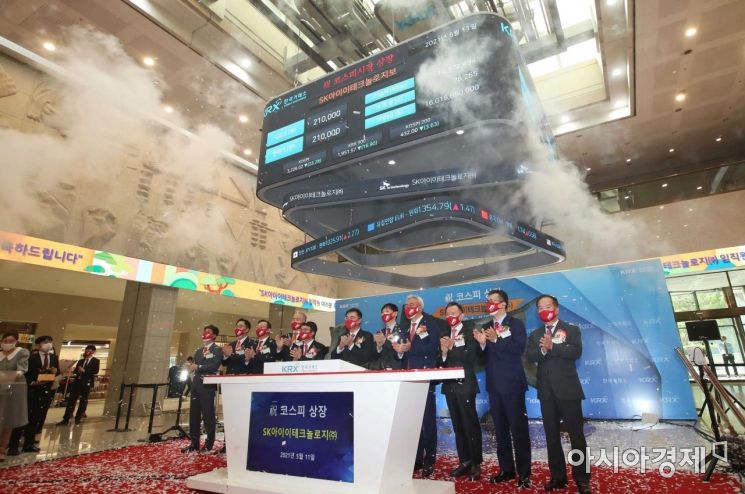 On the morning of the 11th, attendees are taking a commemorative photo for the start of trading at the SK IE Technology (SKIET) listing ceremony held at the Korea Exchange in Yeouido, Seoul. From the left: Song Young-hoon, Deputy General Manager of the Korea Exchange KOSPI Market Headquarters; Ahn Sang-hwan, Chairman of the Korea IR Council; Lee Cheon-gi, Head of Credit Suisse Securities Korea; Park Tae-jin, Seoul Representative of JP Morgan Securities; Lim Jae-jun, General Manager of the Korea Exchange KOSPI Market Headquarters; Son Byung-doo, Chairman of the Korea Exchange; Noh Jae-seok, CEO of SK IE Technology; Kim Jun, CEO of SK Innovation; Choi Hyun-man, CEO of Mirae Asset Securities; Jung Il-moon, CEO of Korea Investment & Securities; Lee Ki-heon, Vice Chairman of the Listed Companies Association. Photo by Kang Jin-hyung aymsdream@
[Asia Economy Reporter Junho Hwang] "KakaoBank, Krafton, Hyundai Engineering, KakaoPay, LG Energy Solution."
This is the list of major initial public offerings (IPOs) scheduled for the second half of this year. It is expected that up to 200 trillion KRW will be concentrated in these IPOs, and concerns have been raised that when these companies appear in the stock market, side effects may occur due to the increased supply of stocks across the market.
According to Eugene Investment & Securities on the 19th, the IPO size of LG Energy Solution is expected to be around 100 trillion KRW. Following that, KakaoBank is projected to have an IPO of 34 trillion KRW, Krafton 22 trillion KRW, and Hyundai Engineering 10 trillion KRW. Combined, this amounts to 200 trillion KRW.
Even excluding LG Energy Solution, the total reaches 100 trillion KRW. This is about 4% of the current KOSPI market capitalization, the highest level since the dot-com bubble of 1999-2000. Currently, the KOSPI market cap is approximately 2,250 trillion KRW, and the KOSDAQ market cap is about 403 trillion KRW.
IPOs are generally considered to have a positive effect on the stock market. Active IPOs indicate smooth capital raising by companies, which is seen as supportive of the stock market.
However, if IPOs occur intensively, that is, if the stock supply increases by more than 2-3% of the market size (market capitalization), the situation changes. The expansion of stock supply limits stock price growth. A representative example is the dot-com bubble. At that time, the rapid increase in capital increases and IPOs overheated the market, which later became a burden on stock prices. Similar situations occurred in China during 2006-2007. When China Petrochemical (PetroChina) was listed, the stock supply size exceeded 3-4% of the market capitalization, and the Shanghai Composite Index underperformed for two years thereafter.
Researcher Jaehwan Heo of Eugene Investment & Securities Research Center stated, "Although the momentum for economic recovery in the second half of the year will slow down, the strategy to increase the weighting of risk assets remains valid," adding, "However, the supply-demand burden caused by large-scale IPOs in the second half is expected to limit the upside."
© The Asia Business Daily(www.asiae.co.kr). All rights reserved.
![Clutching a Stolen Dior Bag, Saying "I Hate Being Poor but Real"... The Grotesque Con of a "Human Knockoff" [Slate]](https://cwcontent.asiae.co.kr/asiaresize/183/2026021902243444107_1771435474.jpg)
















