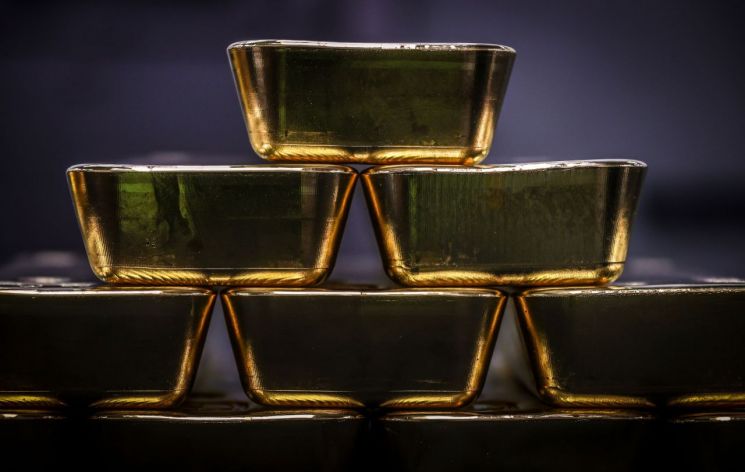
[Asia Economy Reporter Minji Lee] Gold prices, which had been stagnant for a while, are rebounding as they gain attention as an inflation hedge (risk avoidance) tool.
On the 19th, the June gold futures price traded on the New York Mercantile Exchange recorded $1869.20 per troy ounce as of the 18th (local time). After reaching the $1900 level in January, it fell to the high $1600s but is now showing an upward trend again.
Gold prices, a representative physical safe-haven asset, move inversely to risk assets. From the end of last year to early this year, as preference for risk assets such as stocks strengthened, gold remained relatively weak. From mid-February, as interest rates and the dollar strengthened, the decline in gold prices accelerated, and in early March, domestic gold prices fell to their lowest level in a year since March last year. Because gold does not yield interest, when interest rates rise, its price falls, and when the value of the safe-haven dollar rises, gold prices also decline. Recently, with the surge in interest rates and the dollar value calming down and inflationary pressures increasing, gold's appeal as a hedge tool has been highlighted.
Accordingly, domestic gold prices are also showing an upward trend. According to the Korea Exchange, on the 18th, the price per gram of 1 kg gold spot in the KRX gold market closed at 68,200 KRW, up 0.56% from the previous trading day, marking a three-day consecutive rise. This is the highest closing price since January 8, when it was 68,320 KRW, closely approaching the yearly high (69,230 KRW on January 6).
As demand for inflation hedging grows, silver spot prices are also rising accordingly. Silver prices are recently trading around $28 per troy ounce, recovering to the February level of the yearly high ($29). Soohyun Kim, a researcher at Daishin Securities, said, “Investment attractiveness of gold and silver is expected to increase due to the inflow of inflation hedge demand. The increase in gold demand in Asian markets and silver demand due to U.S. infrastructure policies are also expected to influence price rises.”
© The Asia Business Daily(www.asiae.co.kr). All rights reserved.
![User Who Sold Erroneously Deposited Bitcoins to Repay Debt and Fund Entertainment... What Did the Supreme Court Decide in 2021? [Legal Issue Check]](https://cwcontent.asiae.co.kr/asiaresize/183/2026020910431234020_1770601391.png)















