Plant Photosynthesis Cell Made with Thylakoid + Ruthenium Oxide Sheet
[Asia Economy Reporter Kim Bong-su] A technology has been developed that stores electrical energy generated during the photosynthesis process of plants for use in other applications.
The National Research Foundation of Korea announced on the 19th that a domestic and international joint research team led by Professor Ryu Won-hyung succeeded in developing a plant photosynthesis battery made from thylakoids extracted from spinach and ruthenium oxide sheets, which powered a small calculator.
Plants absorb light and split water during photosynthesis to produce hydrogen ions, oxygen, and high-energy photosynthetic electrons. Since photosynthetic electrons are generated when only light and water are supplied to thylakoids, which are photosynthetic complexes present in chloroplasts, research has continued to create batteries from thylakoids to produce eco-friendly electricity.
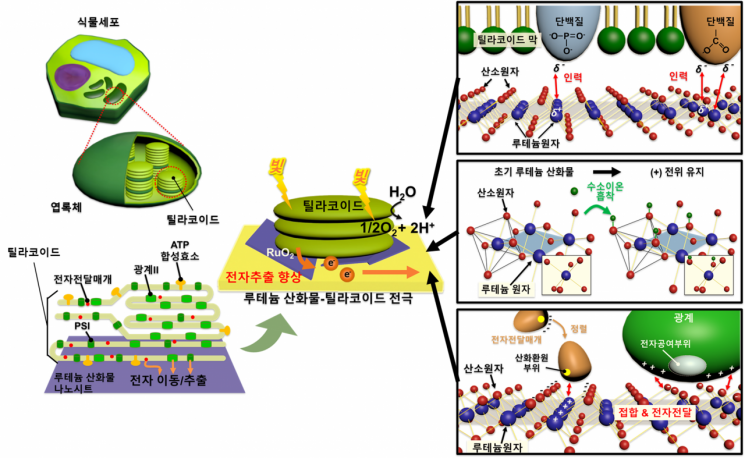
The key challenge was attaching the negatively charged thylakoids to the electrode surface, which is also negatively charged. The use of chemical bonds or mediators to facilitate attachment caused losses during the transfer of photoelectrons, resulting in low photoelectron extraction efficiency.
The research team fabricated ruthenium oxide electrodes in the form of thin two-dimensional nanosheets, similar to paper, which can firmly bond with thylakoids themselves, and designed a photosynthesis battery applying this. The photosynthesis battery consisted of a cathode where thylakoids were attached to the ruthenium oxide electrode to extract photosynthetic electrons, and an anode made of a carbon electrode containing a platinum catalyst. The fabricated photosynthesis battery measured an open-circuit voltage of approximately 420 mV, a maximum short-circuit current of 8.84 μA, and a maximum power of 0.74 μW at a 1 cm² area of photosynthesis on the cathode side.
The ruthenium oxide nanosheets have a polar surface, which is advantageous for adhesion to other materials and can be applied to electrodes in small amounts. In fact, thylakoids applied to gold electrode surfaces coated with ruthenium oxide remained attached even after washing with strong water pressure, whereas most thylakoids attached to uncoated gold electrodes were found to have detached.
Furthermore, the research team connected four photosynthesis batteries, linking thylakoids obtained by centrifugation from spinach to ruthenium oxide nanosheet electrodes in series, successfully powering a small calculator. This demonstrated a clue that photosynthetic electrons, which serve as an energy source for carbohydrate synthesis within plants, can be utilized as an electrical energy source.
The results of this study were published online on the 12th in the international academic journal Science Advances.
© The Asia Business Daily(www.asiae.co.kr). All rights reserved.