1.56 Billion KRW Invested
Distribution of Rooftop Self-Consumption Solar Power Systems for Houses and Buildings
[Asia Economy Yeongnam Reporting Headquarters Reporter Choi Soon-kyung] Jinju City, Gyeongnam Province announced on the 18th that it will actively promote the renewable energy dissemination project this year with a total budget of 1.56 billion KRW.
Specifically, the projects include the housing support project, mini solar power dissemination project, solar power dissemination project for low-income multi-family housing, and building support projects such as livestock barns.
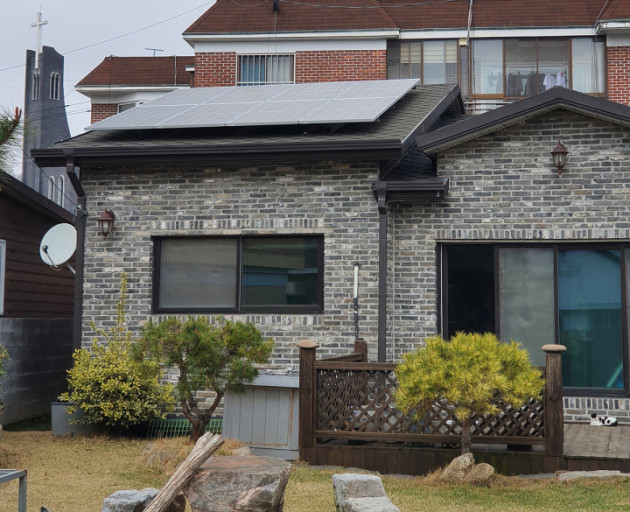
The "Housing Support Project" supports the installation of solar power systems that produce 3 kW capacity electricity for self-consumption in houses, providing 960,000 KRW per household for 228 households, with each household bearing 1.34 million KRW. For households using 300 kWh of electricity per month, this can save about 500,000 KRW annually on electricity bills.
Under the "Mini Solar Power Dissemination Project," 630,000 KRW is supported per household for 150 households. If applied jointly and performance rewards are received, installation can be done for around 20,000 KRW, saving electricity equivalent to the consumption of a 500ℓ double-door refrigerator (28?33 kWh) per month.
The city recommended that households living in multi-family housing without suitable places to install 3 kW solar power systems apply for the mini solar power dissemination project, which allows installation on veranda railings.
Additionally, since the 7th local government administration, the city has been promoting projects that provide subsidies for installing solar power on buildings for the first time, with the solar power dissemination project for low-income multi-family housing and renewable energy building support projects as representative examples.
The "Solar Power Dissemination Project for Low-Income Multi-Family Housing" uses a budget of 320 million KRW to install solar power on the rooftop idle spaces of two rental apartment complexes, reducing electricity costs for residents by powering shared facilities such as elevators and underground parking lot lighting.
The "Building Support Project for Livestock Barns and Others" provides a subsidy of 8 million KRW per site when solar power is installed on livestock barns and general buildings for self-consumption purposes.
A city official stated, "We plan to continue expanding support for solar power dissemination for self-consumption purposes to respond to the government's renewable energy dissemination expansion policy and to promote continuous eco-friendly energy diffusion."
© The Asia Business Daily(www.asiae.co.kr). All rights reserved.

















