Application for 'Consent Resolution' Containing Midnight Correction Proposal
[Asia Economy Reporter Kim Heung-soon] The Fair Trade Commission (FTC) is drawing attention as Samsung Electronics and other major Samsung affiliates have applied for a 'consent decree' expressing their intention to voluntarily correct allegations that they funneled in-house cafeteria contracts to the catering company Samsung Welstory. A consent decree is a system where a company under investigation by the FTC for fair trade issues prepares a voluntary corrective plan, which the FTC reviews and then closes the case without determining whether there was a legal violation. The business community views it as desirable for the FTC and Samsung to seek a direction that quickly improves the catering market and enables cooperation with small and medium-sized enterprises, rather than delaying through legal disputes.
Efficiency of Consent Decree Also Recognized by FTC
According to related industries on the 18th, the FTC plans to review Samsung's corrective plan submitted with the consent decree application and discuss whether to accept it at the plenary meeting scheduled around the 26th. Originally, this plenary meeting was intended to determine the level of sanctions by compiling opinions from the FTC secretariat and major Samsung affiliates regarding allegations that Samsung funneled in-house cafeteria contracts to Samsung Welstory, but the agenda changed after Samsung submitted a voluntary corrective plan.
The consent decree process proceeds by the FTC reviewing the corrective plan submitted by the business operator and deciding whether to initiate the procedure. If initiated, a provisional consent decree is prepared within 30 days. Then, for up to two months, the FTC collects opinions from stakeholders and related ministries before finalizing the plan.
Previously, the FTC classified the in-house cafeteria catering business as a monopolistic industry and raised suspicions of unfair contract allocation by large corporations. Since 2018, it has investigated allegations that major Samsung affiliates unfairly supported the catering company Samsung Welstory. Samsung stated, "We have demonstrated in the FTC investigation that this was a 'normal transaction,' and this position remains unchanged," but also explained, "Considering that catering transactions have not been diverse, we applied for a consent decree to promptly improve this and focus on the business."
The FTC has also positively evaluated the consent decree system. At a recent press conference, FTC Chairman Cho Sung-wook said, "Even if corrective measures are imposed, there is a problem that it takes a long time until final confirmation due to appeals in court," and added, "If well operated, the consent decree is a good option the FTC can choose because it can quickly remedy the victims."
Also Used to Resolve Disputes of Global Companies
In Korea, the consent decree system was first introduced through the amendment of the Fair Trade Act in December 2011. Major countries such as the United States, the European Union (EU), Germany, and Japan have operated this system earlier. In particular, there are cases where this system was applied to global companies to quickly resolve suspicious cases.
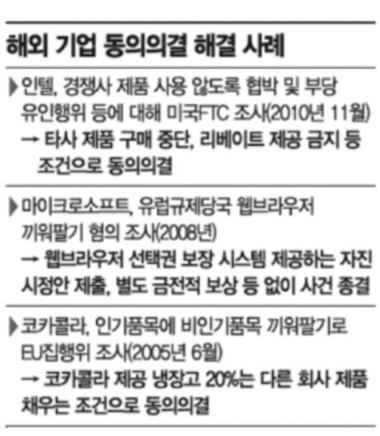
According to the Korea Customs Service and the FTC, Coca-Cola was investigated by the EU Commission in 2005 for unfair trade practices of tying unpopular products with popular ones in the EU region. At that time, Coca-Cola submitted a corrective plan allowing at least 20% of refrigerators provided by the company to be filled with other companies' products and obtained consent.
American company Intel was investigated by the U.S. Federal Trade Commission (FTC) for allegations of threatening computer manufacturers not to use competitors' products and unfair inducements. Intel submitted a corrective plan banning rebates conditioned on stopping purchases of other companies' products and received a consent decree.
In Korea, there is the case of Apple, which was investigated for allegations such as shifting advertising and free repair costs to domestic mobile carriers. The FTC accepted Apple's corrective plan in February, which included support measures worth 100 billion won.
© The Asia Business Daily(www.asiae.co.kr). All rights reserved.
!["The Woman Who Threw Herself into the Water Clutching a Stolen Dior Bag"...A Grotesque Success Story That Shakes the Korean Psyche [Slate]](https://cwcontent.asiae.co.kr/asiaresize/183/2026021902243444107_1771435474.jpg)

















