Jeong Se-eun, Professor of Economics at Chungnam National University, Proposes Through Yejeoncheo's 'Yesan Chunchoo'
"A Socially Integrative Approach Can Serve as a Breakthrough for Tax Increase"
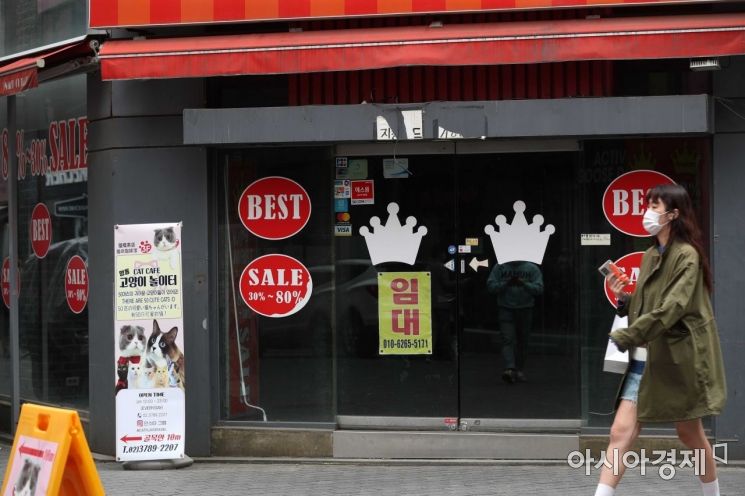 Vacant stores have been steadily increasing in major commercial districts due to the prolonged COVID-19 pandemic. Myeongdong, Seoul's representative commercial area, is in a serious condition with 4 out of 10 stores empty. According to the "2021 Q1 Commercial Real Estate Lease Trend Survey" released by the Korea Real Estate Board, the vacancy rate of medium to large stores in Myeongdong was recorded at 38.4%. Rental inquiries, temporary closure, and business termination signs are posted on Myeongdong shops.
 Photo by Moon Ho-nam munonam@
[Sejong=Asia Economy Reporter Kim Hyunjung] There have been calls for the introduction of a 'social solidarity tax,' a temporary increase in income tax and corporate tax over three years to respond to COVID-19. It is argued that a socially integrative approach that imposes a slight tax burden on groups benefiting from the COVID-19 special demand could serve as a breakthrough for tax increases.
Jung Se-eun, a professor in the Department of Economics at Chungnam National University, recently stated this in the 'Budget Chunchoo' issue diagnosis 'Social Solidarity Tax as a Breakthrough for Overcoming K-Polarization' published by the National Assembly Budget Office. Professor Jung explained, "The International Monetary Fund (IMF) recently proposed a plan to additionally collect taxes on income, property, and wealth from affluent groups to use as resources for overcoming the crisis," adding, "I would like to propose a social solidarity tax similar to this but more progressive and without using the concept of excess profits."
The social solidarity tax he advocates involves a temporary tax increase on income tax and corporate tax for three years, raising income tax rates by 5 to 15 percentage points for taxable income exceeding 46 million won and corporate tax rates by 3 percentage points for taxable income exceeding 20 billion won, which is similar to the recent proposal by the People's Solidarity for Participatory Democracy (2021). Professor Jung added, "It would be acceptable to slightly modify the taxable income brackets and rates," and "Since the principle is to apply this to all income, not only earned income but also business income and capital gains will be subject to taxation."
Regarding this tax reform, he emphasized, "It can be designed as a new earmarked tax or implemented by temporarily adjusting the structure of income tax and corporate tax," adding, "If so, it can be linked to welfare projects related to disaster recovery, similar to the special disaster solidarity tax."
He expressed opposition to calls for introducing a 'wealth tax' that burdens asset owners. He stressed, "The comprehensive real estate tax has already been strengthened, raising rates to a meaningful level in the upper taxable income brackets to function similarly to a wealth tax," and "Introducing a new independent wealth tax before the strengthened comprehensive real estate tax is fully implemented does not seem desirable, especially since real estate is expected to be the main target."
Regarding skepticism about the significance of the social solidarity tax given its expected modest revenue scale, he argued, "The meaning is more important in the broader context of tax reform after COVID-19 than the revenue scale," adding, "It is intended to secure resources to support vulnerable groups with a progressive tax increase plan, which exactly aligns with the reform direction that future tax reforms should pursue."
He also said it could play an important role in the upcoming full-scale welfare tax increase phase. Professor Jung pointed out, "The delay in welfare tax increases so far is because politicians fear the decline in approval ratings it may cause," adding, "It is not necessary to assume that the public is entirely negative about tax increases. Rather, resistance may be strong because people do not know how much their lives and those of others will improve when taxes increase." He also noted, "Compared to other OECD countries, France had a very small role for income tax, but by introducing the General Social Contribution (CSG), it was able to dramatically enhance the role of income tax as a welfare resource in a short period," adding, "The social solidarity tax is a proposal by civic groups to be introduced temporarily, but if public support grows in the future, it can be expanded and reorganized into a social security tax and used as an important means for a high-level welfare state."
© The Asia Business Daily(www.asiae.co.kr). All rights reserved.

















