Two New Stations in East Busan and Two Additional Chargers in Sasang-gu, Expanding to Four Locations by Year-End
1,200 Hydrogen Vehicles to be Supplied This Year, Easing Charging Inconvenience for Existing 1,070 Vehicles
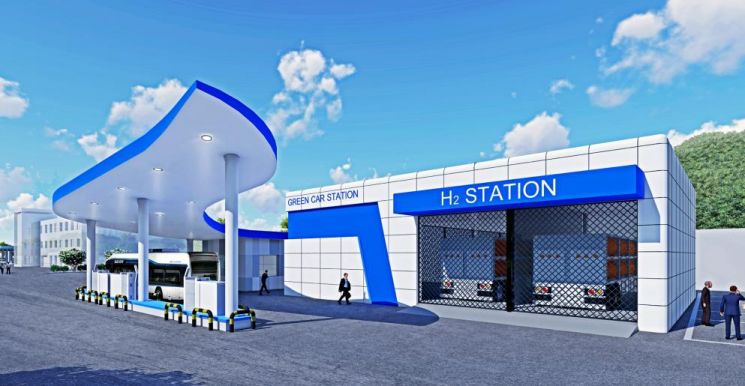 Perspective view of the Dongbusan Public Garage Hydrogen Bus Charging Station in Cheonggang-ri, Gijang-gun, Busan, scheduled for completion in December this year.
[Asia Economy Yeongnam Reporting Headquarters Reporter Kim Yong-woo] Two more hydrogen car charging stations will be added in Busan this year.
Busan City (Mayor Park Hyung-jun) announced on the 18th that construction permits for hydrogen charging stations have been completed in Jeonggwan-eup, Gijang-gun, and Songjeong-dong, Haeundae-gu, and that a total of four stations, including the existing ones in Songjeong-dong, Gangseo-gu, and Hakjang-dong, Sasang-gu, will be operational by the end of this year.
Two additional chargers will also be installed at the existing H Busan Hydrogen Charging Station in Hakjang-dong, Sasang-gu, which is expected to somewhat reduce the inconvenience for hydrogen car users.
The number of hydrogen vehicles registered in Busan has been increasing since 2019, currently with about 1,070 hydrogen passenger cars (Nexo) and 20 hydrogen buses. This year, the plan is to supply 1,200 hydrogen passenger cars and 20 hydrogen buses.
Currently, Busan has had only one hydrogen charging station each in Gangseo-gu and Sasang-gu since 2019, and no additional stations have been installed, causing hydrogen vehicle users to face long waiting times or the difficulty of charging at distant locations.
To resolve this, the city has been working to add more charging stations in Dong-gu, Gijang-gun, and Haeundae-gu, but has faced difficulties due to local residents' opposition, site issues, and lack of business feasibility.
Recently, the situation improved with the acquisition of construction permits in Gijang-gun and Haeundae-gu. Additionally, in the 2021 public offering for private operators of hydrogen charging stations for commercial vehicles, Busan was selected for two of the 16 nationwide locations (Yongdang-dong, Nam-gu, and Hakjang-dong, Sasang-gu), which is expected to further ease the situation.
Hydrogen is a flammable substance but is the lightest gas, so in case of leakage, it disperses quickly, reducing the risk of explosion. According to the risk analysis by the American Institute of Chemical Engineers, hydrogen is rated as less hazardous than city gas.
The hydrogen storage tanks in hydrogen vehicles have passed 17 safety tests including rupture, flame, shooting, and drop tests, and can withstand the weight of the Eiffel Tower (7,300 tons).
Moreover, hydrogen charging stations use internationally certified components identical to those in advanced countries, and have multiple safety measures such as explosion-proof and safety structures, emergency shut-off devices, gas leak alarms, strict safety inspections by the Korea Gas Safety Corporation before use, and on-site safety managers during operation.
Since the announcement of the 'Hydrogen Economy Roadmap' (January 2019), the government has been making large-scale investments and revising related laws and systems to foster the hydrogen industry.
With the goal set by the '2050 Carbon Neutrality Declaration' (December 2020), the transition to eco-friendly vehicles and the spread of hydrogen energy are accelerating. Hydrogen energy is no longer a future concept but a present reality.
Busan Mayor Park Hyung-jun emphasized, “In this era of energy paradigm shift, it is necessary to foster a correct understanding of hydrogen, promote a positive perception of a hydrogen society, and build public consensus toward becoming a marine hydrogen city for sustainable development and improved quality of life.”
© The Asia Business Daily(www.asiae.co.kr). All rights reserved.

















