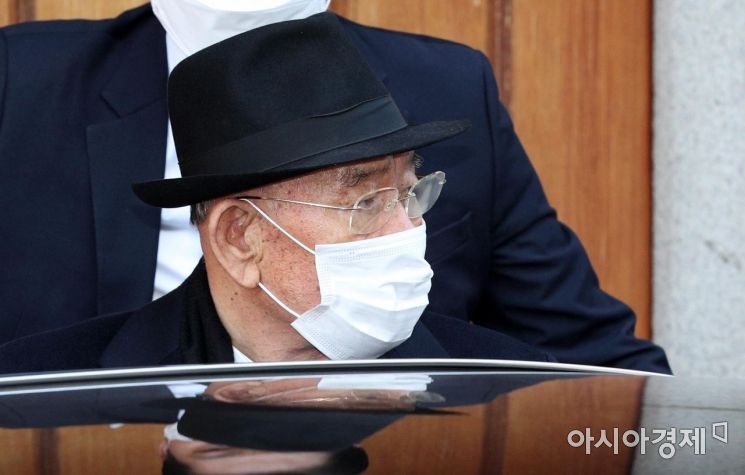
 On November 30 last year, former President Jeon Du-hwan was leaving his residence in Yeonhui-dong, Seodaemun-gu, Seoul, to attend the first trial sentencing hearing for the defamation of the deceased case held at the Gwangju District Court. Photo by Kim Hyun-min kimhyun81@
[Asia Economy Reporter Choi Seok-jin] Former President Jeon Du-hwan lost again in the second trial of his defamation lawsuit against a media outlet that reported he gave the order to shoot during the May 18 Democratic Movement.
According to the legal community on the 18th, the Seoul High Court Civil Division 13 (Presiding Judges Kang Min-gu, Jung Moon-kyung, Jang Jeong-hwan) recently dismissed former President Jeon's appeal in the defamation lawsuit against the comprehensive programming channel JTBC, upholding the first trial's ruling that ruled against the plaintiff.
The court stated, "Even when considering the evidence properly adopted and examined in the first trial along with additional evidence adopted and examined in the appeal trial, the fact-finding and judgment of the first trial are justified."
JTBC reported from March to May 2019, citing testimonies from Kim Yong-jang, a U.S. military intelligence officer during the May 18 incident, and Oh Won-gi, a driver for the commander of the 706 Security Unit, that former President Jeon gave the order to shoot to the martial law troops when he went down to Gwangju on May 21, 1980.
In response, former President Jeon filed a lawsuit in August of the same year requesting a correction of the report.
Earlier, the first trial court ruled against the plaintiff, stating that the JTBC article was not about 'facts' but merely 'opinions.'
At that time, the court premised, "This report reveals new testimonies from Kim Yong-jang and others concerning the plaintiff's visit to Gwangju on May 21, 1980, meetings with Jeong Ho-yong and others, and the order to shoot at protesters, and is structured as a flow tracing the credibility of these statements."
It further judged, "Rather than using definitive expressions implying the existence of facts, it merely introduces new claims from Kim Yong-jang and others that contradict the plaintiff's assertions."
Moreover, the court added, "Even if the defendant stated specific facts that could harm the plaintiff's social reputation, the evidence submitted by the plaintiff alone is insufficient to recognize them as false."
© The Asia Business Daily(www.asiae.co.kr). All rights reserved.

















