[Asia Economy Reporter Ji-hwan Park] It has been revealed that companies considered 'excessive time spent on audit responses' as the biggest challenge during last year's financial audit process.
Global accounting and consulting firm EY Han Young announced this on the 17th through the results of the '2020 Financial Audit and Digital Audit Perception' survey.
EY Han Young conducted the survey from March 22 to 31, targeting a total of 338 employees from corporate finance, accounting, and audit departments.
When asked about problems or difficulties experienced during last year's financial audit period (multiple responses allowed), 40.2% of respondents cited 'excessive time spent on audit responses.' This was followed by 'unexpected issues raised during year-end audits' (37.9%) and 'duplicate requests for audit materials' (30.5%).
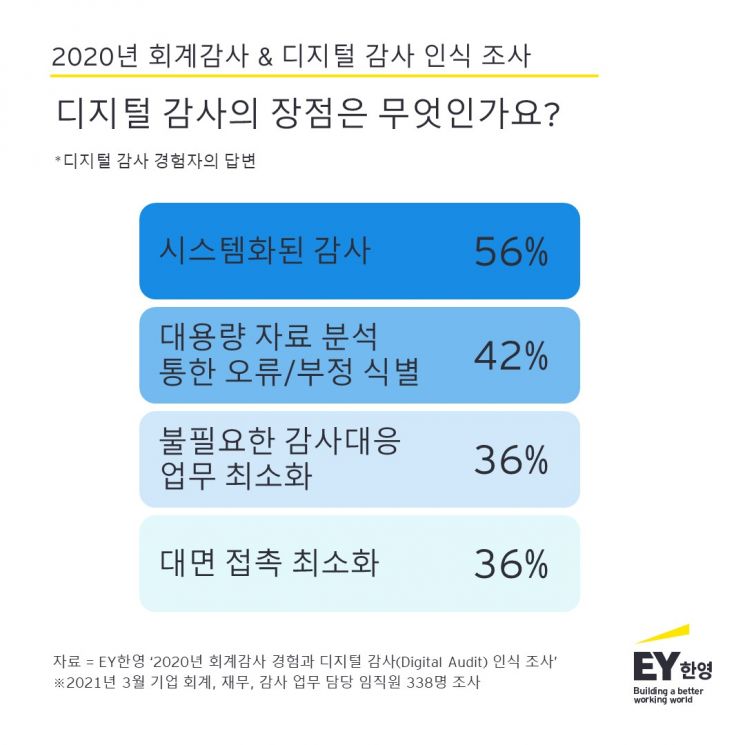
Among respondents who reported experiencing digital audits during last year's year-end audit period, 55.9% identified 'systematized audit procedures' as the greatest advantage of digital audits. Next were 'error and fraud detection through large-scale data analysis' (42.4%) and 'minimization of unnecessary audit response tasks' (35.6%).
Lee Kwang-yeol, Head of the Audit Division at EY Han Young, stated, "This means that, along with responding to changes in accounting and audit environments due to COVID-19, existing problems in financial audits can also be improved through digital audits." He explained that systematized audit procedures can minimize duplicate requests for materials and excessive audit response tasks, and that large-scale data analysis functions can detect errors early.
Digital audit is an audit approach that enhances the effectiveness and efficiency of audit procedures by utilizing digital tools such as digital platforms for financial audits, large-scale data analysis programs, online audit material submission and management systems, and other automation programs.
When asked about 'digital audit functions that should be newly introduced or strengthened in the future,' 56.8% of all respondents cited 'non-face-to-face work processing functions such as online platforms.' This was followed by 'automation of audit procedures' (50%) and 'large-scale data analysis technology' (37%).
© The Asia Business Daily(www.asiae.co.kr). All rights reserved.

















