"Revise Regulations That Violate Student Rights"
Some Schools Still Regulate Underwear, Sparking Controversy
Teacher Groups Say "If Dress Code Provisions Are Completely Abolished, Student Guidance Becomes Difficult"
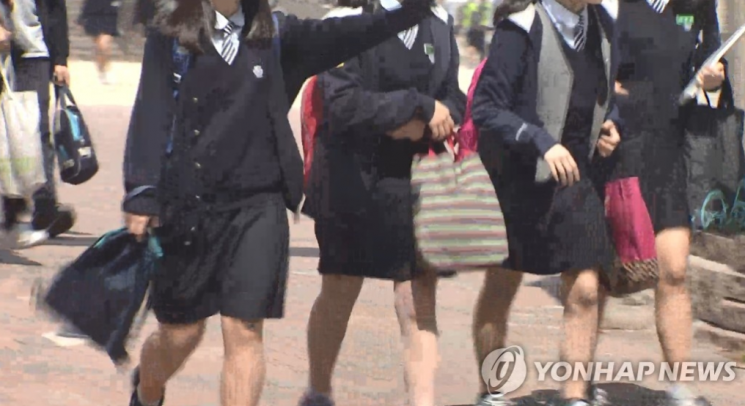
[Asia Economy Reporter Heo Midam] "Underwear must be either white or apricot color. Socks with patterns are not allowed. To wear pants, you need to bring a dermatology certificate." (A student at Seoul S Girls' High School)
"If hair length exceeds 30cm below the ear, you get demerit points, and ambiguous cases were measured with a ruler to decide. Those whose hair touched their shoulders had to tie it up, and if not tied, they received demerit points. These incidents happen every time with the reason 'not being student-like,' but I wonder what the standard for 'being student-like' is." (A graduate of Busan G Girls' Middle School)
These are cases of dress code regulations reported by students to the youth human rights organization 'Asunaro.' In March this year, the Seoul Metropolitan Council passed an amendment to the Student Human Rights Ordinance to delete school rules regulating students' hair and dress. However, some schools still restrict even the color of socks and underwear, causing controversy. Students are protesting that excessive dress and hair regulations are 'human rights violations.' Teacher organizations oppose excessive dress code cases but worry that removing all regulations could make student guidance difficult.
Recently, voices of students opposing school dress regulations have continued. One student posted a petition titled 'Please have the Education Office revise the regulations that violate student rights' on the Seoul Metropolitan Office of Education's student petition board.
The petitioner, who identified herself as attending a girls' high school in Seoul, said, "Currently, Seoul City enforces the 'Student Human Rights Ordinance.' However, I feel that this ordinance is not effective at every moment I spend at school," and "I still have to wear a suffocating vest under my coat, suffer stomach pain from wearing uncomfortable uniforms because I cannot wear sportswear to and from school, and receive insulting remarks from teachers for wearing striped socks or not buttoning my vest."
She continued, "There are many schools where the most problematic regulation on girls' underwear has not disappeared," and "The reason these phenomena persist is that most schools do not take the Student Human Rights Ordinance seriously and feel no pressure from it."
This petition had received 465 endorsements as of 1 p.m. on the 17th. Petitions on the Seoul Metropolitan Office of Education's student petition board that receive more than 1,000 endorsements require a direct response from the superintendent or department head within 30 days.
Earlier this year, controversy arose when it was revealed that some girls' middle and high schools in Seoul regulated the color, pattern, and transparency of students' underwear and stockings in their school rules.
At that time, Moon Jang-gil, a Seoul city council member (Democratic Party), investigated the student life regulations of girls' middle and high schools in Seoul and found that 9 out of 44 middle schools (20.5%) and 22 out of 85 high schools (25.9%) regulated underwear color, pattern, and transparency.
In response to criticism of 'excessive student human rights violations,' on March 5, the Seoul Metropolitan Council passed an amendment to the Student Human Rights Ordinance deleting school rules regulating hair and dress.
However, there are still criticisms that schools continue to enforce dress regulations ignoring students' human rights. In particular, some schools still impose regulations related to underwear.
According to reports disclosed by 'Asunaro' at the end of last month, a girls' high school in Seoul had a regulation stating, "When wearing summer uniforms, a white or apricot-colored undershirt must be worn under the blouse so that underwear is not visible."
Meanwhile, another girls' high school in Seoul stipulated that "When wearing summer uniforms, 1 demerit point will be given for any underwear other than plain white."
The education sector expressed opposition to such excessive dress regulations but argued that some regulations are necessary for student life guidance.
Earlier, a survey conducted by the Korean Federation of Teachers' Associations (KFTA) in early 2019 targeting 787 teachers from elementary, middle, and high schools showed that 82.7% of respondents opposed revising the enforcement decree to abolish dress and hair regulations. The most cited reason for opposition was "deterioration of the study atmosphere due to reduced authority in life guidance."
Park Ho-cheol, spokesperson for the Seoul Federation of Teachers' Associations (Seoul KFTA), also said, "Excessive dress regulations need to be eased in line with the times. However, it is inappropriate to label all dress-related regulations as 'outdated ideas,'" adding, "If all dress regulations are abolished, schools may face difficulties in guiding students' lives."
He added, "Schools need to sufficiently gather students' opinions and establish rules within a range that does not cause discomfort to either side."
© The Asia Business Daily(www.asiae.co.kr). All rights reserved.
![Clutching a Stolen Dior Bag, Saying "I Hate Being Poor but Real"... The Grotesque Con of a "Human Knockoff" [Slate]](https://cwcontent.asiae.co.kr/asiaresize/183/2026021902243444107_1771435474.jpg)


















