Achievements of the Joint Research Team at Korea Electronics and Telecommunications Research Institute
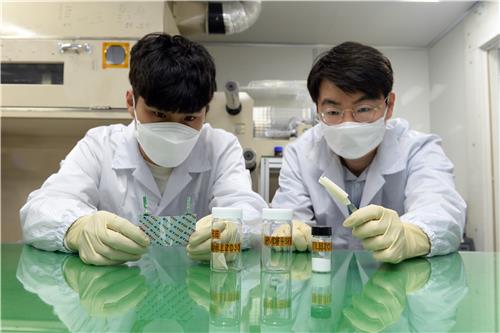 The Electronics and Telecommunications Research Institute (ETRI) announced on the 17th that a joint research team led by Dr. Shin Dong-ok and Professor Kim Sang-wook of KAIST has developed a hybrid electrolyte for secondary batteries that combines organic materials (flexible polymers like liquids) and inorganic materials (solids), resulting in high conductivity without fire risk. The photo shows the ETRI research team testing the characteristics of a battery with the hybrid electrolyte applied. [Image source=Yonhap News]
[Asia Economy Reporter Minyoung Cha] A hybrid electrolyte that mixes organic materials (polymers flexible like liquids) and inorganic materials (solids) has been developed, which has no fire risk while possessing high conductivity.
The Electronics and Telecommunications Research Institute (ETRI) announced on the 17th that a joint research team led by Dr. Dongok Shin and Professor Sangwook Kim of KAIST developed a secondary battery electrolyte material with no explosion risk.
Unlike primary batteries that are used once and discarded, secondary batteries can be used semi-permanently through charging, and are actively researched in various fields such as smartphones, electric vehicles, and home appliances.
Existing liquid electrolytes used in secondary batteries pose fire and explosion risks, so secondary batteries using solid electrolytes have attracted attention. However, solid electrolytes have limitations such as high interfacial resistance depending on the material or complicated processing.
The research team confirmed that the ion resistance layer naturally formed on the surface of inorganic solid electrolyte materials is the cause of reduced conductivity performance. Accordingly, they rapidly removed the ion resistance layer using a dry etching method employed in semiconductor processing.
Based on solid electrolyte particles with the ion resistance layer removed interface, they manufactured a hybrid electrolyte that succeeded in doubling the ion conductivity compared to existing electrolytes and increasing charge-discharge performance by more than three times.
Dr. Dongok Shin of ETRI said, "We plan to conduct follow-up research to improve charge-discharge performance through controlling the interface between the electrode and electrolyte and optimizing the electrolyte thickness."
© The Asia Business Daily(www.asiae.co.kr). All rights reserved.

















