Detection of Emergency Situations Such as Visitor Fever and Fire
Reducing Service Delay Time Through MEC
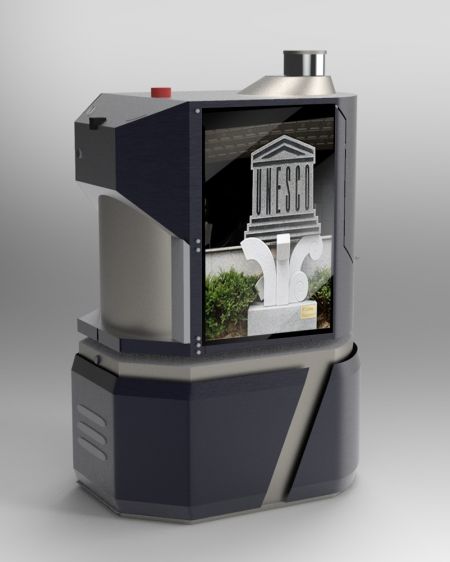 LG Uplus announced on the 17th that it has won a project to discover 5G convergence services and apply public-leading initiatives using mobile edge computing at the 5.18 Memorial Culture Center in Gwangju Metropolitan City. The photo shows a 5G MEC intelligent robot. Photo by LG Uplus
[Asia Economy Reporter Cha Min-young] LG Uplus announced on the 17th that it has won a project to discover 5G convergence services using Mobile Edge Computing (MEC) and apply them as public leading projects at the Gwangju Metropolitan City 5·18 Memorial Culture Center and other locations.
MEC refers to a network technology that processes data close to users, such as at base stations or exchanges, without transmitting it to the backbone network or data centers (IDC). This reduces traffic load on the backbone network and shortens latency for specific services.
Starting in the second half of this year, an AI-guided and quarantine robot based on 5G MEC will be installed and operated at the 5·18 Memorial Culture Center. Equipped with indoor positioning LiDAR, this robot monitors visitors' body temperature and indoor fire, and uses AI video analysis to detect emergencies such as visitors fainting in real time. In case of an emergency, the robot uses stored voice messages to request help from nearby people. It also informs managers of the situation on site through two-way communication services.
The screen installed on the robot provides information about the center and offers customized guidance services for visitors. At the 5·18 Memorial Park, ‘Smart Poles’ equipped with complex Internet of Things (IoT) sensors such as fever-detecting CCTV will be installed to manage visitor safety. The media walls installed in the park are made of semi-transparent glass that does not spoil the park’s scenery. Even in crowded plazas, they can provide real-time information on quarantine, announcements, environmental data, and performance events.
Meanwhile, LG Uplus’s Gwangju MEC Center plans to provide an MEC platform for the Gwangju Smart City based on domestic equipment and open-source software, complying with the standards of the European Telecommunications Standards Institute (ETSI). Through this, they aim to build and operate a stable MEC platform.
In addition, LG Uplus plans to expand 5G MEC application cases through various government projects in fields such as ▲5G Smart City (environmental management in residential areas with smart poles and autonomous robots) ▲5G Smart Industrial Complex (safety and environmental management with hazard monitoring biometric signal analysis safety helmets, air quality monitoring, etc.) ▲5G Ports (remote control of cranes and support for logistics warehouse automation).
Kang Jong-oh, head of LG Uplus’s Smart City Business Division, said, “We will expand 5G MEC in public services that citizens can experience to increase technology maturity and strive to successfully establish a 5G MEC convergence ecosystem.”
© The Asia Business Daily(www.asiae.co.kr). All rights reserved.

















