Autonomous District Contest, On-site Evaluation, and Presentation Review Select 'Jungnang-gu' as Target Area
Promoting Water Cycle Restoration Using Rainwater Infiltration and Discharged Groundwater in 'Sangbong-dong' Area with Over 80% Impervious Rate
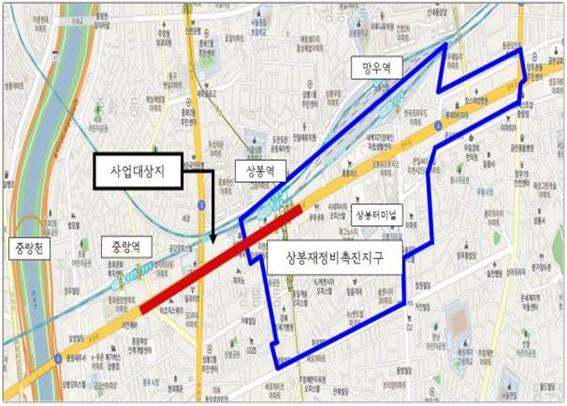
[Asia Economy Reporter Lim Cheol-young] A citizen-experienced water circulation street combining the city, cutting-edge water circulation facilities, and nature will be created between Jungnang Station and Sangbong Station, where citizens frequently pass.
On the 17th, Seoul City announced that Jungnang-gu was selected as the final target site for the ‘Smart Water Circulation City Creation Project’ and that 3 billion KRW in project funds will be supported over two years. A total of five autonomous districts applied for the ‘Smart Water Circulation City Creation Project’ contest, and after on-site evaluations and presentation reviews, the appropriateness, public interest, and feasibility of the project were comprehensively assessed.
The Sangbong-dong area in Jungnang-gu received high scores in all evaluation categories, including a high impermeability rate of over 80%, large utilization of discharged groundwater, field applicability, effectiveness in restoring water circulation, citizen experience, and maintenance plans. This year, basic and detailed designs will be carried out, and construction will be completed in 2022.
The Smart Water Circulation City Creation Project is a future-oriented project that diversely combines abundant water resources such as rainwater, discharged groundwater, and recycled water according to regional characteristics to provide them to citizens and create economic benefits by utilizing water resources like discharged groundwater.
Underground along Mangwoo-ro in Sangbong-dong, the project site, 1,300 tons of discharged groundwater from the KEPCO power duct was being discarded daily through sewage pipes. By utilizing this discharged groundwater for various purposes through this project, it is expected to save 200 million KRW annually in sewage fees and 500 million KRW annually in treatment costs by reducing processing at the Jungnang Water Reclamation Center, totaling a savings effect of 700 million KRW.
Seoul City plans to install water supply devices to provide water for cleaning and landscaping for citizens to use and install hydrants along the roads to supply water to street cleaning vehicles. Additionally, a Clean Road System will be installed in the center of Mangwoo-ro to spray discharged groundwater on the road, removing street dirt and non-point pollutants, and cooling fogs will be installed throughout the sidewalks to create a clean and cool street.
When rainfall occurs on Mangwoo-ro causing road runoff, a water circulation structure will be created where water flows through rainwater inlets into plant cultivation pots, which serve as non-point pollutant reduction facilities. In this process, polluted water is purified, and rainwater is allowed to infiltrate underground through an ‘infiltration trench,’ contributing to the restoration of urban water circulation. The infiltration trench is a facility filled with large gravel or similar materials beneath the catch basin that sends rainwater to the sewage pipe, increasing permeability so that rainwater can seep into the ground.
Furthermore, to allow citizens to easily check the project effects such as rainwater infiltration volume, heat island mitigation, and fine dust reduction, smart sensors will be installed on water level gauges, flow meters, thermometers, and fine dust measuring devices. Related information will be displayed in real-time on electronic boards and a touch-screen information delivery system (kiosk), enhancing citizen convenience.
Since the project site overlaps with the Sangbong Redevelopment Promotion District, it is expected that when large-scale buildings are constructed in the future with recycled water facilities installed, they can be linked and utilized with the ‘Sangbong-dong Smart Water Circulation City.’
Choi Jin-seok, Director of the Water Circulation Safety Bureau, said, "The Smart Water Circulation City Creation Project in Sangbong-dong, Jungnang-gu, selected this time, will be completed by next year, and we plan to continuously expand and promote one site annually until 2030." He added, "Through this, we expect a synergy effect not only in restoring Seoul’s water circulation but also in enhancing the value of water resource utilization."
© The Asia Business Daily(www.asiae.co.kr). All rights reserved.
![User Who Sold Erroneously Deposited Bitcoins to Repay Debt and Fund Entertainment... What Did the Supreme Court Decide in 2021? [Legal Issue Check]](https://cwcontent.asiae.co.kr/asiaresize/183/2026020910431234020_1770601391.png)















