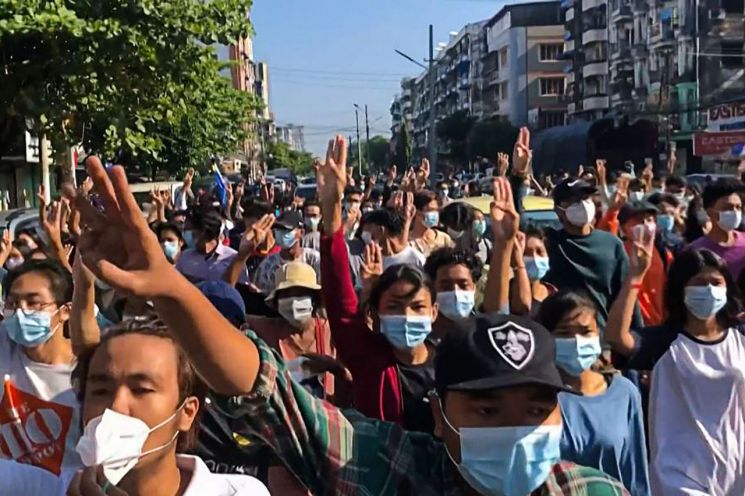
 On the 2nd (local time), in Yangon, Myanmar's largest city, protesters denouncing the military coup held a flash mob-style street demonstration, performing the "three-finger salute," a symbol of resistance against dictatorship. [Image source=Yonhap News]
[Asia Economy Reporter Hwang Sumi] Japan's largest daily newspaper, Yomiuri Shimbun, published an article on the 16th highlighting the rising status of South Korea in Myanmar. The article analyzed that South Korea has strongly condemned the military coup that occurred in Myanmar and that many Myanmar citizens empathize with South Korea's May 18 Gwangju Democratization Movement.
According to this article, published in the form of a signed column by Norimasa Tahara, Director General of the Asia Bureau, a survey conducted by Japanese residents in Myanmar targeting locals found that 89% of respondents named South Korea as the country whose image improved after the military coup. In contrast, only 46.9% chose Japan.
The survey revealed that the reasons Myanmar citizens chose South Korea included opinions such as "issued a strong statement condemning the coup" and "stood on the side of the Myanmar people."
Regarding this, Director General Tahara explained that Japan, which has had longstanding relations with the Myanmar military, has been criticized for its ambiguous stance on the coup, whereas South Korea's criticism of the Myanmar military was clearly strong.
He also mentioned another reason for the increased favorable sentiment toward South Korea among Myanmar people. He explained that many Myanmar citizens empathize with South Korea's democratization movement, saying "we have gone through the same thing," and regard it as an ideal.
Director General Tahara particularly asserted that the film "A Taxi Driver," which centers on the May 18 Gwangju Democratization Movement, played a significant role in enhancing South Korea's favorable image.
Released in August 2017 and attracting 10 million viewers, the film "A Taxi Driver" tells the story of German journalist J?rgen Hinzpeter, who revealed the truth of Gwangju to the world during the Gwangju Democratization Movement, and taxi driver Kim Sa-bok, who took him into the barricaded city of Gwangju and drove around the protest sites.
Director General Tahara said that many people on Myanmar's social networking services (SNS) recommend the film "A Taxi Driver." He conveyed the local atmosphere by quoting a Myanmar university student who said, "What is happening in our country right now is exactly the same. South Korea understands our pain and anger."
 On the 13th, a "Religious Community Press Conference Urging International Response to the Myanmar Military Coup" was held near the U.S. Embassy in Seoul. [Image source=Yonhap News]
Meanwhile, domestic cultural and artistic figures issued a statement condemning the Myanmar military's suppression of the cultural and artistic community and expressed solidarity with the local cultural and artistic resistance movement against the military. According to the Human Rights Center of the National Council of Churches in Korea (NCCK) on the 14th, 37 domestic cultural and artistic organizations and 355 individuals from fields such as film and theater released a statement saying, "We support the courageous resistance of Myanmar's cultural and artistic community and condemn the military's barbaric suppression."
Additionally, on the 13th, domestic religious organizations urged the international community to actively respond to the Myanmar military's violence. Buddhist Action for Democracy in Myanmar, Won-Buddhism Civil Society Network, the Catholic 'Franciscan JPIC,' and the interfaith coalition International Climate and Religion Citizens (ICE) Network held a press conference at Gwanghwamun Square in Seoul that day, demanding, "The international community must immediately devise and implement measures to stop the Myanmar military's acts of massacre."
© The Asia Business Daily(www.asiae.co.kr). All rights reserved.
![Clutching a Stolen Dior Bag, Saying "I Hate Being Poor but Real"... The Grotesque Con of a "Human Knockoff" [Slate]](https://cwcontent.asiae.co.kr/asiaresize/183/2026021902243444107_1771435474.jpg)

















