At the 'Gwangju Declaration' Press Conference: "Mentioned Only One Way to Alleviate National Conflict"
Right to Life, Safety, and Housing of the People Must Be Immediately Pursued by the Next Administration Through Constitutional Amendment
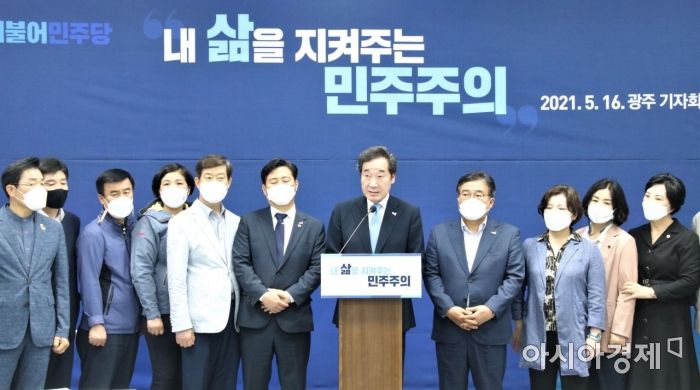 Former Democratic Party leader Lee Nak-yeon is holding a 'Gwangju Declaration' press conference at the Democratic Party Gwangju Metropolitan City Office on the 16th.
[Asia Economy Honam Reporting Headquarters Reporter Yoon Jamin] Former Democratic Party of Korea leader Lee Nak-yeon officially apologized for the “former president pardon theory,” which he faced heavy criticism for earlier this year after reaching the peak of his presidential bid.
On the 16th, Lee held a “Gwangju Declaration” press conference at the Democratic Party of Korea’s Gwangju Metropolitan City branch, stating, “I mentioned it as one of the measures to ease conflicts among the people for South Korea to move forward into the future,” and added, “I apologize for not fully understanding the will of the people and the spirit of the candlelight protests.”
He continued, “Since then, I have engaged in painful reflection and have learned a lot,” and said, “I will make sure not to neglect paying attention to the will of the people going forward.”
He also spoke about constitutional amendments aimed at institutionalizing socio-economic democracy.
He said, “It has been 34 years since the 1987 Constitution was enacted. During that time, there have been many developments, such as ending long-term rule and transferring power through the hands of the people,” but added, “However, various sectors of society have solidified into a winner-takes-all structure, causing widespread unfairness and inequality.”
He further stated, “The time has already passed for the Constitution to accommodate the changes of the era and the demands of the people,” and declared, “In Gwangju, the sacred place of democracy, I present to the people a constitutional amendment for ‘democracy that protects my life.’”
He continued, “Reducing inequality means transforming the winner-takes-all structure into one of coexistence and cooperation, and strengthening the state’s responsibility for that should be the core of the constitutional amendment,” emphasizing, “I propose adding the rights to life, safety, and housing to the Constitution.”
He added, “I hope it will be further specified to improve unfairness and inequality caused by land issues,” and explained, “We must clearly define the contents of balanced national development to prevent local extinction and enhance the effectiveness of local fiscal decentralization.”
Regarding the 41st anniversary of the May 18 Democratic Uprising this year, he said, “May 1980 in Gwangju was the most tragic sacrifice for South Korean democracy and has become its proudest history,” and added, “May 18 became a catalyst for South Korean democracy and has now been elevated to a textbook of global democracy.”
He also emphasized, “We must continue tirelessly toward completing unfinished tasks such as uncovering the truth about May 18.”
Lee presented two points for the future of Gwangju.
First, he stressed that the Moon Jae-in administration’s pledge of the Gwangju-Daegu Dalbit Inland Railroad is essential for balanced national development and East-West harmony, urging the government to include it in the 4th National Railroad Network Construction Plan.
He also demanded that the Blue House and the Prime Minister’s Office take the lead in accelerating the military airport relocation project.
Meanwhile, with the presidential election next year approaching, Lee has begun full-scale activities and has been busy capturing the hearts of the Honam region, the Democratic Party’s stronghold, over weekends and holidays.
Starting with a lecture for university students in the Gwangju-Jeonnam area on the 13th, he has been actively engaging with Honam by visiting the National May 18 Democratic Cemetery daily and cleaning tombstones while carrying out his schedule in Gwangju.
© The Asia Business Daily(www.asiae.co.kr). All rights reserved.

















