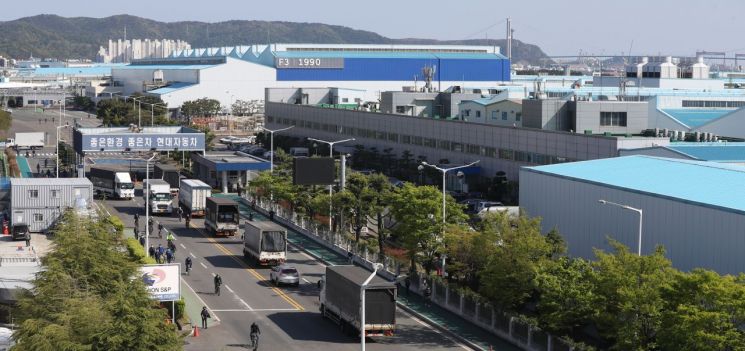
[Asia Economy Reporter Yu Je-hoon] The "bottleneck" in automotive semiconductors is becoming a reality. Some plants of Hyundai Motor and Kia have stopped operations due to semiconductor supply shortages, and delays in new car deliveries are also occurring one after another.
According to the industry on the 15th, Hyundai Motor and Kia will suspend operations of Ulsan Plant 5 Line 52 and Soha Plant 2 on the 17th and 18th, respectively, due to semiconductor component supply shortages for parts such as the Airbag Control Unit (ACU). The models produced at these two plants include the compact SUV Tucson, hydrogen electric vehicle Nexo, and small SUV Stonic.
In addition, Ulsan Plant 3, which produces the compact sedan Avante and small SUVs, will also halt operations on the 18th.
Until the first quarter, Hyundai Motor and Kia were somewhat free from the global shortage of automotive semiconductors, but since last month, repeated factory shutdowns and resumptions due to this issue have affected vehicle production. In fact, last month, Ulsan Plant 1 and Asan Plant stopped operations, and on the 6th and 7th of this month, Ulsan Plant 4, which produces the Porter, also suspended and then resumed operations. Kia has also stopped most weekend overtime work.
This is not a problem unique to Hyundai Motor and Kia. Korea GM has also reduced the operating rates of Bupyeong Plant 2, as well as Bupyeong Plant 1 and Changwon Plant, which produce popular models such as the Trailblazer and Spark, to about half due to semiconductor supply shortages.
Delays in new car deliveries are also becoming commonplace. According to the industry, Hyundai Motor's Tucson requires a waiting period of 6 to 8 months from contract to delivery, and Kia's Sorento also requires about 6 to 7 months. Hyundai Motor recently sent a letter signed by Vice President Yoo Won-ha, head of the domestic business division, to customers waiting for delivery, stating, "The global shortage of automotive semiconductors is prolonged," and added, "Hyundai Motor is making every effort to deliver vehicles to customers as soon as possible by discovering alternative semiconductor suppliers and improving production operation efficiency."
Meanwhile, the industry expects the automotive semiconductor supply shortage to peak in the next 1 to 2 months. An industry official said, "It is difficult to expect a dramatic improvement in the supply situation for the time being," and added, "It is highly likely that factory shutdowns and resumptions will continue repeatedly for the time being."
© The Asia Business Daily(www.asiae.co.kr). All rights reserved.

















