Web Drama 'Joso Joso Jojoso'... Recently Popular on YouTube
Over 2 Million Views from the First Episode
Set in a Company with Fewer Than 10 Employees... "Brings Back Trauma"
Wage Gap with Large Corporations Not the Top Concern for Job Seekers
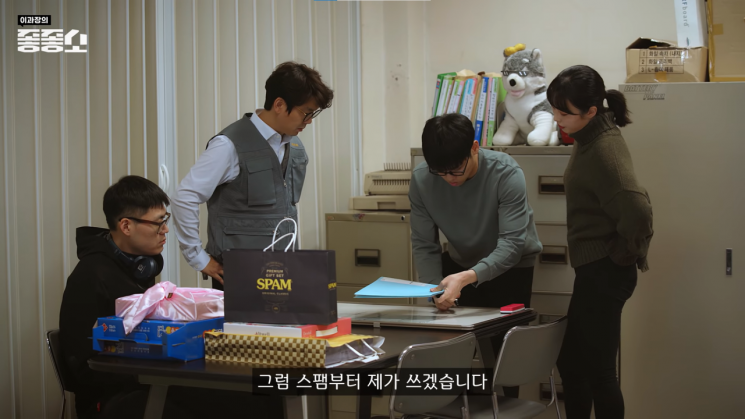 A scene from episode 7 of the YouTube web drama "Joso Joso Jojoso." Employees are sharing holiday gifts through a "Sadari Tagi" game.
 [Photo by YouTube channel 'Igwa-jang']
[Asia Economy Reporter Joonhyung Lee] “This is not a drama, but a documentary.”
This is a comment from a netizen who watched the web drama "Jossoso Jossoso Jossoso Company (Jojjoso)" which recently gained great popularity on YouTube. It reflects the evaluation that it showed the reality of some small and medium-sized enterprises (SMEs) without any embellishment.
Jojjoso recorded over 2 million views from the very first episode. Including trailers, the cumulative views reach about 25 million. Considering that the drama was planned and produced without large capital investment, this is a significant achievement.
Weak Systems and Widespread Power Abuse... Empathy Rooted in Anger
The logistics company "Jeongseung Network," the setting of the drama, is an SME with fewer than 10 employees. The company’s system is weak, and power abuse is rampant everywhere. The CEO recalls it is interview day when a job seeker comes to the office. When the new employee requests to write a labor contract, the CEO retorts, “That’s something you go by trust.” The only manager scolds the new employee for not using the ‘apjonbeop’ (a Korean hierarchical speech rule), citing mental education. Respect for workers is virtually nonexistent.
The reason for its success is simple. Jojjoso directly addresses the harsh working conditions of some SMEs, which have rarely been seen in existing dramas. It may be extremely uncomfortable for some, but it is a story that resonates deeply with others?those who have worked or are working at SMEs like Jeongseung Network. This empathy is easily confirmed through netizens’ comments.
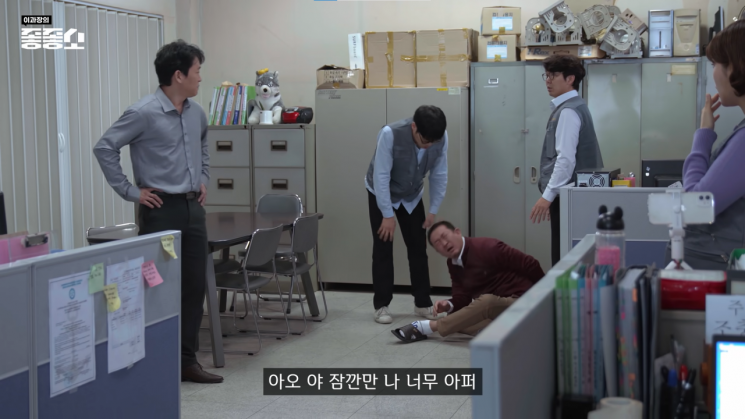 A scene from episode 15 of the YouTube web drama 'Joso Joso Jojoso'.
 [Photo by YouTube channel 'Igwa-jang' video capture]
Their empathy is based on anger. They have suffered from disrespect by superiors, irrational organizational culture, and illegal labor practices. One netizen said, “It brings back trauma from working at such a company,” adding, “Every word from the boss was just as aggressive.” Another netizen said, “If you have similar experiences, PTSD (Post-Traumatic Stress Disorder) kicks in, making it hard to watch properly,” and “It’s so ‘real’ that your face stiffens.” They all pointed out, “This is why people avoid working at SMEs.”
Reasons for Avoiding SMEs Not Only About Salary... 'Organizational Culture' Also Matters
Many companies believe the ‘SME avoidance phenomenon’ stems from the wage gap between large corporations and SMEs. According to JobKorea, 43% of HR managers at 388 domestic SMEs cited ‘low salary levels’ as the reason for difficulty in recruiting personnel.
The wage gap is indeed one of the reasons behind the avoidance phenomenon. According to a survey conducted last month by the Korea Federation of SMEs targeting 1,000 young job seekers, one in four job seekers (25.9%) said ‘salary satisfaction’ is their top priority when job hunting.
The problem is that salary gap is not the only reason. In the survey, salary satisfaction ranked second among considerations. The first was ‘work-life balance guarantee’ (27.9%), and third was ‘healthy organizational culture and workplace atmosphere’ (12.9%). ‘Company growth potential’ (10.1%) and ‘job stability’ (10%) followed.
Voices concerned about job mismatch sometimes criticize job seekers, questioning whether it is necessary to insist on large corporations. There are also complaints that young people’s expectations are too high.
However, before criticizing job seekers, there is an opinion that the reality of SMEs should be reconsidered. Yoon Suhyun (26, pseudonym), a second-year job seeker, said, “Most job seekers don’t ask for much,” adding, “They just want to be able to work with respect.”
This is why SMEs worried about recruitment difficulties should pay attention to Jojjoso. Professor Park Jongmin of Kyung Hee University’s Department of Media and Communication said, “Since the target of the YouTube web drama is the younger generation, SMEs are one of the appropriate topics for the main audience,” and “The reason for its success may be that people in their 20s and 30s felt a sense of affinity with what happened in SMEs.”
© The Asia Business Daily(www.asiae.co.kr). All rights reserved.
![Clutching a Stolen Dior Bag, Saying "I Hate Being Poor but Real"... The Grotesque Con of a "Human Knockoff" [Slate]](https://cwcontent.asiae.co.kr/asiaresize/183/2026021902243444107_1771435474.jpg)

















