Seoul Housing Price Increase Rate Similar Before and After 2·4 Measures
Recently, Rise Accelerates, Showing Unstable Signs
Experts: "Effectively a Failure... No Housing Price Stabilization"
Minister Noh Hyung-wook's Term Begins... Focus on Housing Supply
Seoul City's Cooperation, 2·4 Measures Implementation Face Various Challenges
[Asia Economy Reporter Moon Jiwon] It has been 100 days since the government announced the February 4th real estate measures, which centered on a housing supply plan for 830,000 households, on the 14th. However, the market still has not produced concrete results. The Ministry of Land, Infrastructure and Transport expected that signaling an increase in housing supply to the market would stabilize housing prices, but recently, apartment prices in Seoul have instead increased, continuing the confusion.
Attention is focused on whether the newly appointed Minister of Land, Infrastructure and Transport, Noh Hyung-wook, who has shed the label of candidate, will present a differentiated solution for stabilizing housing prices. However, the prevailing view in the market is that it will be difficult to change the trend unless the policy direction is fundamentally altered.
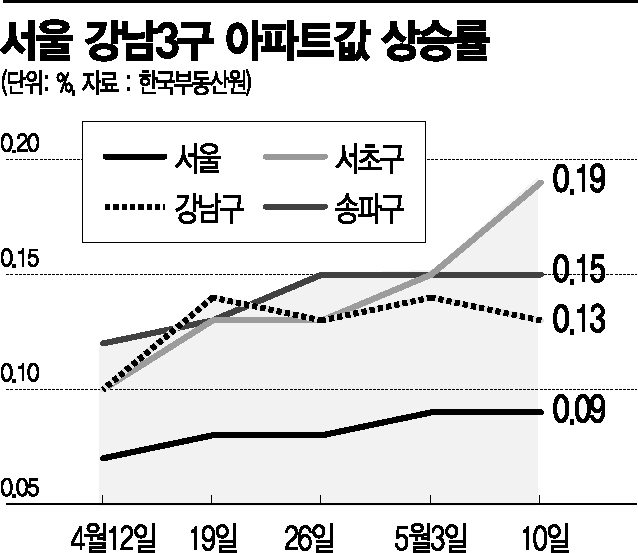
Looking at the statistics from the Korea Real Estate Board on this day, apartment prices in Seoul rose by 0.09% this week, matching the rate of increase recorded in the second week of February, right after the announcement of the February 4th measures. Although the apartment price increase rate has fluctuated over the 100 days, it has never declined and recently has been rising again. There is no significant change in the overall trend compared to before the February 4th measures were announced.
In particular, the Gangnam 3 districts (Gangnam, Seocho, and Songpa), known as the barometer of Seoul housing prices, show a trend of expanding weekly apartment price increases. In Seocho-gu, where redevelopment projects are concentrated, apartment prices have increased over the past three weeks from 0.13% to 0.15% to 0.19%. Compared to the time of the February 4th announcement, the rate of increase has nearly doubled. Although the government described the February 4th measures as a "groundbreaking plan" with "unprecedented incentives," many evaluations give it a failing grade in the mid-term assessment.
The reasons for the minimal effect of the February 4th measures are complex. Public distrust in real estate policies deepened due to the land speculation scandal involving employees of the Korea Land and Housing Corporation (LH) related to the 3rd new town development, and the momentum of the measures was weakened after former Minister Byun Chang-heum, who designed the February 4th plan, resigned in disgrace. The legislative bills underpinning the February 4th measures have not passed the National Assembly, leaving significant doubts about public development among residents. In fact, one of the core components of the February 4th measures, the ‘Urban Public Housing Complex Project,’ has announced up to the third round of candidate sites (38 locations), but none are in the Gangnam area of Seoul. The situation is similar for public redevelopment and public reconstruction projects.
Analysis suggests that the position of the February 4th measures has further diminished following the election of Mayor Oh Se-hoon, who campaigned on easing reconstruction regulations, in the Seoul mayoral by-election. Minister Noh, whose term began on this day, is expected to focus his policy efforts on implementing follow-up measures to the February 4th plan rather than immediately introducing new policies. In a special speech commemorating his 4th anniversary in office on the 10th, President Moon clearly stated the next minister’s task, saying, "Housing supply policies must be executed without delay."
Given the strong opposition from opposition parties to major real estate bills and anticipated difficulties in cooperation with the Seoul city government on housing policies, there are many concerns that Minister Noh, who is not a real estate expert, will find it difficult to lower housing prices. The atmosphere is unsettled due to investigations into speculation allegations involving LH and the Ministry of Land, Infrastructure and Transport by prosecutors and police, and negative public opinion also poses an obstacle. Professor Shim Gyo-eon of Konkuk University’s Department of Real Estate said, "The February 4th measures are essentially a failed policy, making it difficult to achieve housing price stabilization," adding, "The key for Minister Noh will be how he manages to implement some regulatory relaxations mentioned during the confirmation hearing."
© The Asia Business Daily(www.asiae.co.kr). All rights reserved.
!["The Woman Who Threw Herself into the Water Clutching a Stolen Dior Bag"...A Grotesque Success Story That Shakes the Korean Psyche [Slate]](https://cwcontent.asiae.co.kr/asiaresize/183/2026021902243444107_1771435474.jpg)

















