Steady Decline Since Biden's Inauguration... Now Below 40,000
[Asia Economy Reporter Cho Hyun-ui] "Today is a great day."
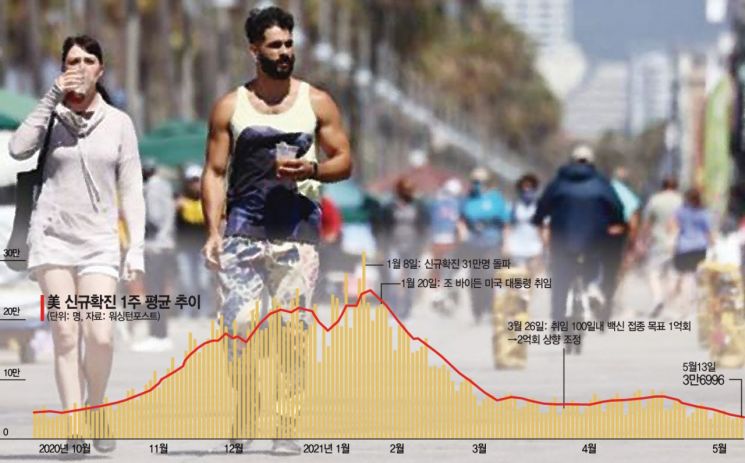
On the 13th (local time), U.S. President Joe Biden said this as he removed his mask following the U.S. Centers for Disease Control and Prevention (CDC) significantly easing indoor and outdoor mask-wearing guidelines. Earlier this year, when infections surged in the U.S., the country transformed into a model for pandemic control with Biden’s inauguration. The combined effects of strengthened social distancing and mask policies contributed, but the biggest factor was the high vaccination rate.
In early January, the U.S. saw daily confirmed cases soar to 300,000. At that time, only 4,225,756 people had completed their first vaccine dose, far below the federal government’s goal of vaccinating 20 million people by the end of last year. However, the situation changed when President Biden took office on January 20. He announced a goal to administer 100 million vaccine doses within his first 100 days and accelerated vaccination efforts.
The Biden administration mobilized the Defense Production Act to boost domestic vaccine production. Although criticized for vaccine nationalism, they focused all efforts on raising vaccination rates. The most notable feature was increasing vaccine accessibility. Active-duty military personnel were deployed to vaccination sites, and dentists, veterinarians, paramedics, and medical students were authorized to administer shots. Additionally, gyms, furniture showrooms, and even amusement parks were used as federal vaccination centers, and cooperation with over 40,000 pharmacies nationwide ensured that 90% of the population could get vaccinated within 5 miles (about 8 km) of their residence.
As a result, the U.S. seven-day average of new cases steadily declined from 195,801 on Biden’s inauguration day to one-third of that (64,657) by February 22. After hovering in the 60,000 range, cases dropped to the 50,000 range on March 7. On March 26, Biden announced that the initial goal had been achieved in 58 days and raised the target to 200 million doses. After fluctuating between 60,000 and 70,000 cases, the number fell below 40,000 for the first time on April 4.
Since the first vaccine was administered by a nurse in Long Island, New York City, on December 14 last year, 46.6% of the entire U.S. population has received at least one dose. Those fully vaccinated with two doses account for 35.8%, meaning more than one in three people.
The U.S. is also accelerating efforts to achieve herd immunity. On the 11th, the U.S. Food and Drug Administration (FDA) authorized the Pfizer vaccine for use in 12- to 15-year-olds. Since about one-quarter of the population is under 18, herd immunity is expected to be achieved soon. Acting FDA Director Janet Woodcock said, "This decision marks a significant step in the fight against COVID-19," adding, "This measure will bring us closer to ending the pandemic."
© The Asia Business Daily(www.asiae.co.kr). All rights reserved.
![Clutching a Stolen Dior Bag, Saying "I Hate Being Poor but Real"... The Grotesque Con of a "Human Knockoff" [Slate]](https://cwcontent.asiae.co.kr/asiaresize/183/2026021902243444107_1771435474.jpg)
















