"Thorough Management of Raw Material Price Fluctuations and Public Utility Charges... Full Effort for Price Stability"
'Transportation Sector Future Car Transition Strategy' to be Established Within the Year
[Asia Economy Reporter Jang Sehee] The government will import more than 40 million eggs additionally in May, following last month. In addition, it plans to maintain stable prices through government stockpile management of rice, cabbage, and other items.
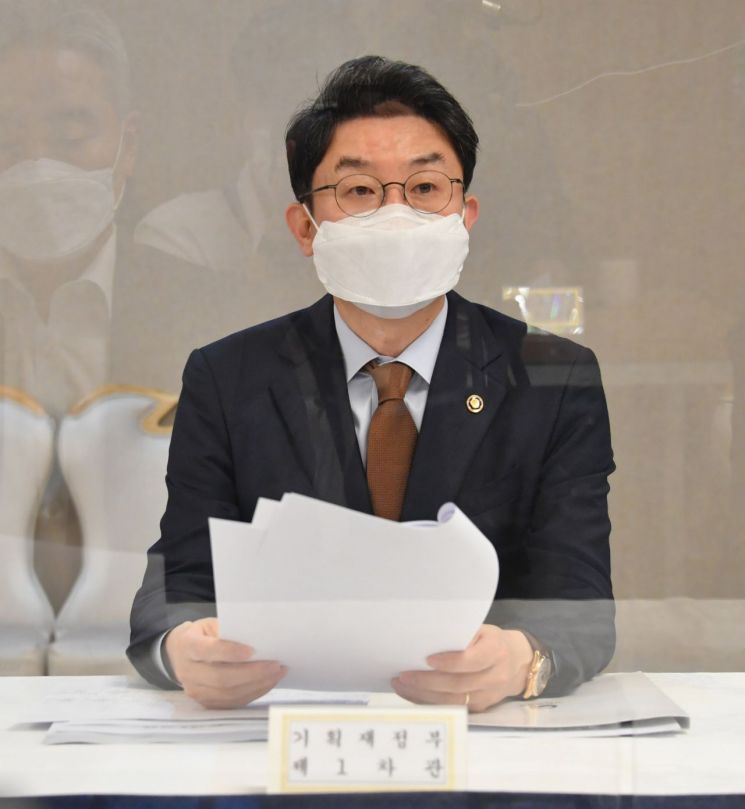
Lee Eokwon, First Vice Minister of the Ministry of Economy and Finance, held the "17th Innovation Growth Strategy Review Meeting, Policy Review Meeting, Korean New Deal Review Meeting, and 11th Price-Related Vice Ministers' Meeting" at the Government Seoul Office on the morning of the 14th to discuss major agricultural and livestock product price trends and response measures.
Vice Minister Lee stated, "Prices of agricultural and livestock products can be highly volatile due to weather conditions and can significantly affect inflation expectations because of their high purchase frequency. Stabilizing agricultural and livestock product prices quickly is very important from the perspective of overall price management."
Accordingly, the government will actively promote customized measures by item. Vice Minister Lee said, "In the case of eggs, following a cumulative 64 million eggs from January to March and 40 million eggs in April, we will additionally import 40 million eggs plus alpha in May to ensure sufficient supply in the market. Also, through government stockpile management, we will maintain stable prices for rice, cabbage, and other items, while strengthening monitoring of shipment trends and growth conditions of green onions and onions, which have been declining since April."
Furthermore, Vice Minister Lee referred to the 2% inflation rate forecasts by the Korea Institute of Finance and the Korea Development Institute (KDI), drawing a line against rapid inflation. He said, "Following the Bank of Korea last month, this week the Korea Institute of Finance and KDI also forecast that this year's inflation rate will not exceed 2%. The government will do its best to manage stable prices this year through early stabilization of agricultural and livestock product prices, responding to raw material price fluctuations, and managing public utility charges."
The government also prepared measures to improve the efficiency of maker spaces to revitalize startups. The government plans to expand specialized labs to 30 locations, double the original target by 2022. Vice Minister Lee emphasized, "We will strengthen linkage and cooperation with K-ICT Device Labs, 3D Printing Regional Centers, and enhance follow-up support such as design and marketing. We will make policy efforts so that maker spaces can become a genuine hub for manufacturing startups."
Meanwhile, to support the implementation of carbon neutrality by 2050, the government announced it will establish a "Future Vehicle Transition Strategy for the Transportation Sector" within the year to promote an ecosystem transition centered on eco-friendly vehicles and strengthen global competitiveness in future vehicles.
© The Asia Business Daily(www.asiae.co.kr). All rights reserved.

















