Two Years and Three Months After Project Implementation... Disaster Response Agencies Communicate Through a Single Network
Over 150,000 Disaster Safety Network Devices to Be Distributed by the End of This Year
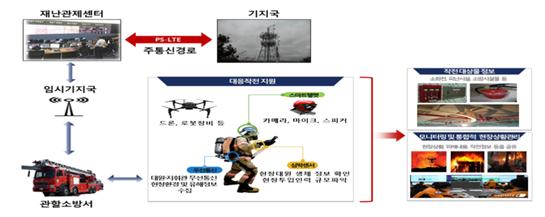
[Asia Economy Reporter Lim Cheol-young] When a large-scale disaster occurs, disaster-related agencies such as the police, fire department, and coast guard will be able to communicate through a single nationwide communication network equipped with 4th generation wireless communication technology (PS-LTE), enabling rapid on-site response. The nationwide unified disaster safety communication network will be fully operational.
On the 14th, the Ministry of the Interior and Safety held a completion and opening ceremony for the disaster safety communication network at the Daegu Operation Center, conducting activities such as completion reports, commemorative speeches, congratulatory messages, opening calls, and ribbon-cutting both online and offline. The disaster safety communication network is a nationwide unified communication network that integrates the communication networks of disaster-related agencies, and Korea is the first in the world to build such a network based on 4th generation communication technology (LTE).
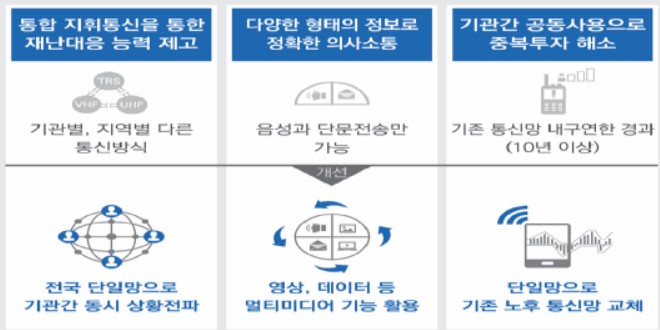
The establishment of the disaster safety communication network is expected to enhance on-site response capabilities during disaster situations. By enabling communication between agencies through a single network instead of separate networks, faster and more effective on-site responses will be possible.
Previously, disaster-related agencies used different wireless communication networks (VHF, UHF, TRS), resulting in many areas where communication was impossible. Sharing situations and joint responses between agencies were difficult, but this problem has been resolved by building a high-quality disaster safety communication network. The existing high-cost, outdated disaster-related communication networks, which have been in use for over 10 years, will be replaced, and with the Ministry of the Interior and Safety overseeing construction and operation, duplication of investments by agencies will be prevented, and economic maintenance will lead to significant budget savings.
The disaster safety communication network was developed in cooperation with KT, SKT, and others, prioritizing survivability and applying various new technologies. To ensure network stability, operation centers were decentralized to Seoul, Daegu, and Jeju, so that even if one center stops or a major device at a specific center fails, uninterrupted network operation is possible.
The disaster safety communication network (PS-LTE), unlike general commercial networks, supports specialized disaster response services such as ▲voice and video group communication for disaster sites (MCPTT) ▲simultaneous transmission technology (eMBMS) developed domestically to alleviate call congestion. By adopting base station sharing technology (RAN-Sharing), interoperability with integrated public networks such as maritime and railway networks using the 700MHz shared frequency band was secured, expanding coverage.
Additionally, it complies with the disaster safety communication standard (PS-LTE Standard Rel.13) established by 3GPP, the international wireless communication standardization organization, and introduced the next-generation addressing system (All-IPv6) for the first time in the world, enabling upgrades (Rel.14~15) such as the Internet of Things (IoT).
The disaster safety communication network allows the use of advanced ICT technologies such as IoT and artificial intelligence (AI), which were impossible with existing wireless networks, enabling the introduction of digital new deal-type smart application services in various disaster safety fields. It can support disaster site activities with drones and wearable devices and be used for providing disaster site information, assessing damage scale, and sharing operational information.
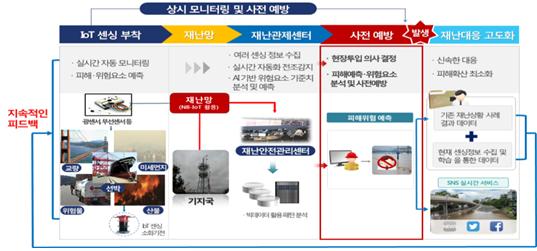
By installing sensors on disaster-vulnerable facilities such as steep slopes, bridges, and reservoirs, real-time monitoring and remote management using IoT technology will enable advanced disaster management. It also allows for solving social safety issues by detecting and preventing risks that threaten public safety in real time, such as services for dementia patients and missing children prevention, smart streetlights, and fine dust monitoring.
Meanwhile, the disaster safety communication network is expected to have significant economic and industrial effects, including fostering related industries, expanding overseas exports, and creating jobs. The entire design, equipment installation, and testing of the disaster network were implemented by domestic telecom companies KT and SKT, and major equipment and core software were developed and commercialized by domestic companies such as Samsung Electronics, Samsung SDS, AM Telecom, and CyberTelBridge.
Currently, about 90,000 disaster safety communication network terminals are in use, and more than 150,000 units will be distributed by the end of this year according to agency purchase plans. The network has already been used to establish communication systems with military units for COVID-19 vaccine transportation.
Minister Jeon Hae-cheol said, “After completing the construction in the metropolitan area last March, we have officially started nationwide operation of the world’s first disaster safety communication network,” adding, “We will realize the project’s effects early by providing not only basic communication functions but also various disaster safety application services so that it can function as a core infrastructure of the digital new deal.”
© The Asia Business Daily(www.asiae.co.kr). All rights reserved.



















