UNIST Professor Junwoo Jeong's Team Proposes Predictive Theory for Quantitative Analysis of Neutron Beam Evaporation and Condensation
Supports Development of Liquid Evaporation in Print Ink and Paint ... Paper Published in 'Matter'
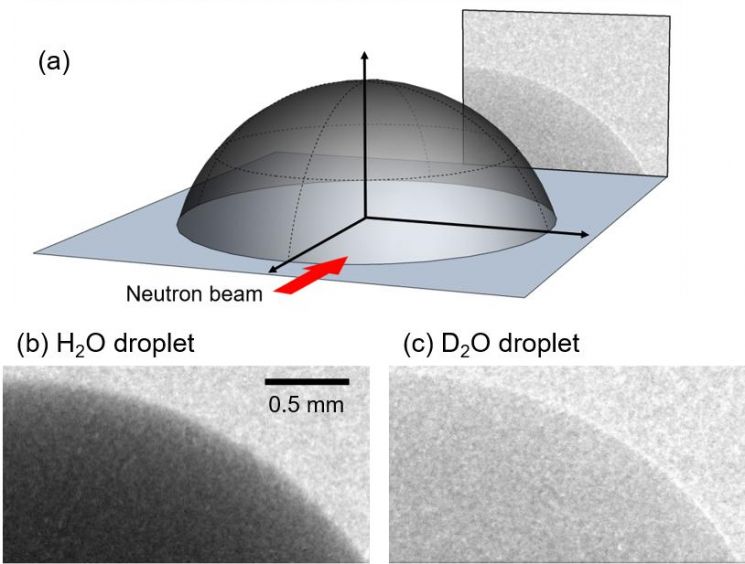 Comparison of neutron imaging between medium water and light water. In the case of light water, the water droplets appear darker.
 [Image source=UNIST]
[Asia Economy Yeongnam Reporting Headquarters Reporter Kim Yong-woo] Is evaporation the only thing happening? Water droplets are not just what we see.
Although not visible to the naked eye, countless water molecules are leaving or entering the surface of the droplets formed on a cup.
Our eyes only see the droplets shrinking due to evaporation, but in reality, condensation is simultaneously occurring as water molecules floating in the air enter the droplets.
Recently, a method has been developed to distinguish these two phenomena and measure the amounts of evaporation and condensation.
This study, which determined the evaporation-to-condensation ratio of solutions, is expected to greatly aid the development of liquids such as paints and inks, where evaporation rates and particle patterns left after evaporation are important.
The research team led by Professor Jeong Jun-woo of the Department of Physics at Ulsan National Institute of Science and Technology (UNIST, President Lee Yong-hoon) succeeded in distinguishing and observing water molecules leaving the droplets and those entering from the air using neutron beams.
This technique analyzes the brightness (transmittance) of images of droplets taken with neutron beams to determine the amounts of water molecules entering and leaving the droplets.
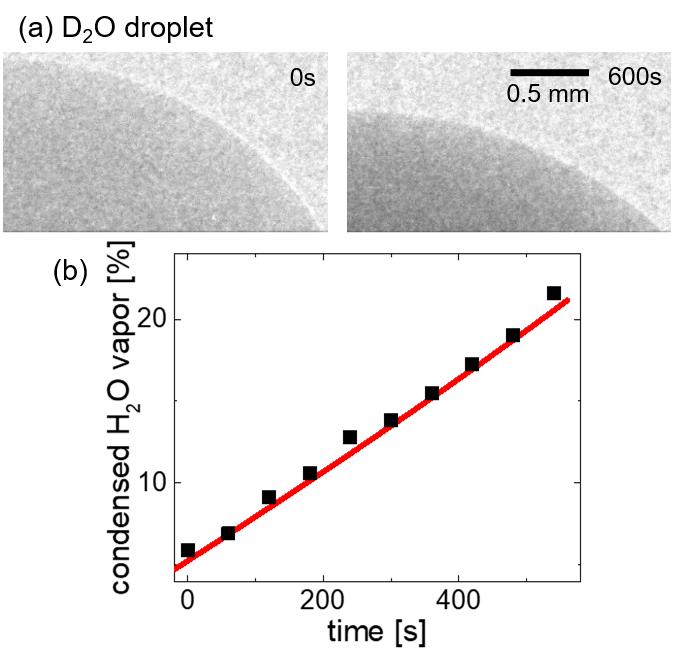 Research results on evaporation and condensation amounts determined through changes in droplet brightness and size. [Image source=UNIST]
Additionally, the research team developed a new theoretical model to predict the evaporation of liquids, including water droplets.
The researchers utilized the phenomenon where the brightness of heavy water droplets darkens over time when photographed with a ‘neutron microscope.’
Heavy water is water in which the hydrogen atoms are replaced by the isotope deuterium. Neutron particles, the light source of the neutron microscope, have different transmittance in heavy water and light water (regular water), with images of light water appearing darker.
Since water molecules in the air are light water molecules, the brightness of the photographed droplet darkens as more water molecules enter. By analyzing this brightness change together with the shrinking of the droplet, it becomes possible to distinguish between evaporation and condensation amounts.
Using this analysis method, the researchers found that when a water droplet of a few millimeters in size evaporates in air with about 30% humidity, approximately 20% of the droplet after 10 minutes consists of water molecules that have entered from outside.
The same results were observed using the existing infrared spectroscopy technique and matched the theoretical model proposed by the researchers for predicting droplet evaporation.
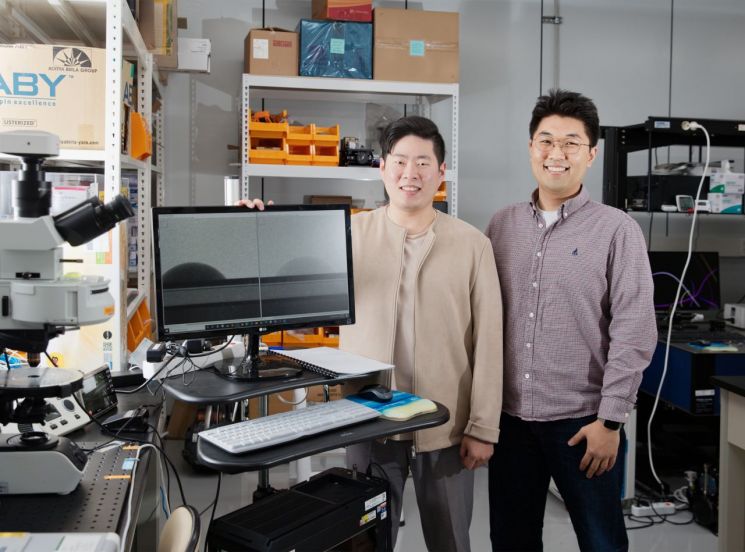 Researcher Jaegwan Lim (left) and Professor Junwoo Jeong (right). The monitor displays photos of heavy water and light water droplets with different brightness levels. [Image source=UNIST]
Injaegwan, the first author and a doctoral researcher in the Department of Physics at UNIST, explained, “Unlike conventional microscopes that use electromagnetic waves such as visible light, the neutron microscope uses neutron matter waves, which allowed us to distinguish between light water and heavy water, inspiring this experiment.”
For high-resolution neutron imaging of droplets, the neutron microscope at the Paul Scherrer Institute in Switzerland was used.
Professor Jeong Jun-woo said, “This research method will be useful for observing evaporation and condensation in various mixed solutions. It can help understand various phenomena involving solution evaporation, such as coating and printing, and aid in developing new inks and paints.”
This study was published online on May 12 in ‘Matter,’ a sister journal of Cell. The research was supported by the Ministry of Science and ICT and the National Research Foundation of Korea (Basic Research Laboratory Support Project), UNIST’s Excellent Research Idea Discovery Project, the Institute for Basic Science’s Center for Soft and Living Matter, and the Paul Scherrer Institute in Switzerland.
© The Asia Business Daily(www.asiae.co.kr). All rights reserved.



















