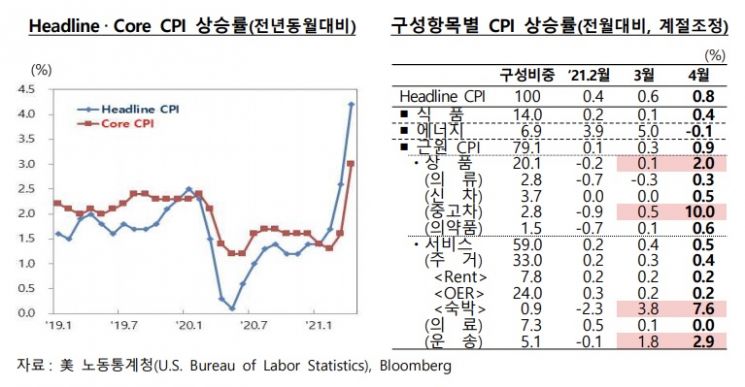
[Asia Economy Reporter Eunbyeol Kim] The Bank of Korea stated that the U.S. Consumer Price Index (CPI) for last month rose 4.2% year-on-year, significantly exceeding expectations, and that "the base effects, increased demand for face-to-face services, and supply bottlenecks that contributed to this inflation will continue to be major drivers of price fluctuations over the coming months."
On the 13th, the Bank of Korea's New York office revealed this in its report titled 'Financial Market Reactions and Assessment of U.S. April Consumer Price Increase,' and predicted that the Personal Consumption Expenditures Price Index (PCE), to be released on the 28th, will show a substantial increase of around 3.3%.
The New York office added, "While rents have shown a moderate upward trend in some areas, it is expected that this trend will gradually expand," and "there is a possibility that the core CPI inflation rate could continuously exceed 2% throughout this year."
Initially, the market had expected the U.S. CPI inflation rate to be about 3.6%. The forecast range was between 3.4% and 3.9%, but the actual CPI increase surpassed even the upper bound of this range. The month-on-month increase was also 0.8%, exceeding the expected range of 0.0% to 0.4%.
The Bank of Korea analyzed that the April U.S. CPI increase was mainly due to a sharp rise in goods prices (2.0% month-on-month). The increase in goods prices was led by the used car sector (10.0%). Despite sharp rises in service prices such as transportation (2.9%) including airfares and lodging (7.6%), the overall increase was limited to 0.5% due to the influence of rent (0.2%), which has a large weight in the index.
Major investment banks (IBs) analyzed that the price increase was mainly due to base effects, the resumption of economic activities in key service sectors, and supply disruptions of major raw materials such as semiconductors.
Goldman Sachs stated, "The April CPI increase was driven by COVID-19 sensitive sectors such as lodging, airfares, and used cars, and this reflation due to temporary factors is expected to continue until late summer." However, it added, "Since used car prices have already reached a high level and price increases expected to occur in summer due to the resumption of economic activities were brought forward to April, there is a possibility of adjustments in some sectors once supply and demand normalize."
© The Asia Business Daily(www.asiae.co.kr). All rights reserved.

![Clutching a Stolen Dior Bag, Saying "I Hate Being Poor but Real"... The Grotesque Con of a "Human Knockoff" [Slate]](https://cwcontent.asiae.co.kr/asiaresize/183/2026021902243444107_1771435474.jpg)















