Foreigners Solely Net Selling on KOSPI
Limited Concern Over US Inflation... Reflecting Expectations for Economic Normalization
Reversal to Rise Uncertain... "A Period of Absorbing Sell-offs Expected for Now"
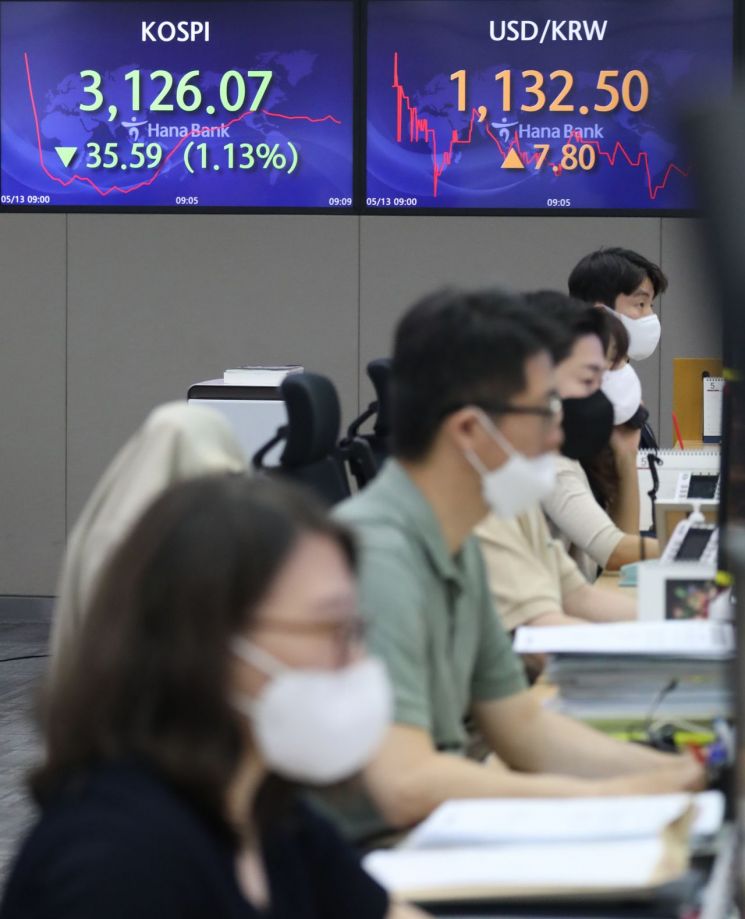 On the 13th, employees are working in the dealing room at the Myeongdong Hana Bank headquarters in Jung-gu, Seoul. [Image source=Yonhap News]
[Asia Economy Reporter Minwoo Lee] The KOSPI, which fell nearly 2% in early trading and threatened the 3100 level, is showing signs of narrowing its intraday losses. The index is being lifted by increased net buying from individuals and institutions. Positive news has emerged, such as forecasts that the spread of COVID-19 in India, which had negatively impacted global stock markets, has already peaked. However, since the index has already risen significantly from its low point, analysts believe further gains will be limited.
As of 10:50 a.m. on the 13th, the KOSPI stood at 3,155.12, down 0.21% from the previous day. After opening lower at 3,146.97 and expanding its losses to as low as 3,103.88 in early trading, it has since recovered all of the lost ground.
Foreign investors continue to sell, but net buying by individuals and institutions appears to be driving the index higher. As of 10:55 a.m. that day, individuals and institutions had net bought 308.1 billion KRW and 186.7 billion KRW, respectively. Meanwhile, foreign investors had net sold 486.2 billion KRW.
The KOSDAQ also fell 0.38% to 963.40 at the same time. After a slightly lower start at 963.31, it dropped nearly 2% from the previous day to 948.04 in early trading but recovered a significant portion of the decline.
On the KOSDAQ, foreign investors and individuals were net buyers, purchasing 34.2 billion KRW and 3.9 billion KRW worth of shares, respectively. Institutions sold 39 billion KRW worth.
Although the U.S. stock market plunged due to inflation concerns after the April Consumer Price Index (CPI) exceeded expectations, the impact on the domestic market was limited. Sangyoung Seo, a researcher at Mirae Asset Securities, explained, "While the weak U.S. stock market may weigh on investor sentiment, more than two-thirds of the price increases were driven by semiconductor chip shortages and rising used car prices, which are related to leisure and travel and can be interpreted as factors reflecting the normalization of the U.S. economy." He added, "According to the Institute for Health Metrics and Evaluation (IHME), the trend of COVID-19 infections in India is expected to improve after peaking in early May, easing related concerns."
As economic normalization progresses, there is analysis that the impact of inflation concerns may be smaller than expected. U.S. President Joe Biden has announced that 60% of the total population will complete their first COVID-19 vaccine dose by next week. Additionally, on the 12th (local time), he met with leaders from both parties at the White House for the first time since taking office to request cooperation on passing a $4 trillion (approximately 4,519 trillion KRW) infrastructure and welfare bill.
However, it remains uncertain whether the index's recovery will lead to a sustained upward reversal. Researcher Seo said, "The index has already risen considerably from its low point," and predicted, "Rather than immediately reversing and surging, the process of digesting selling pressure is likely to continue for some time."
© The Asia Business Daily(www.asiae.co.kr). All rights reserved.
![Clutching a Stolen Dior Bag, Saying "I Hate Being Poor but Real"... The Grotesque Con of a "Human Knockoff" [Slate]](https://cwcontent.asiae.co.kr/asiaresize/183/2026021902243444107_1771435474.jpg)











