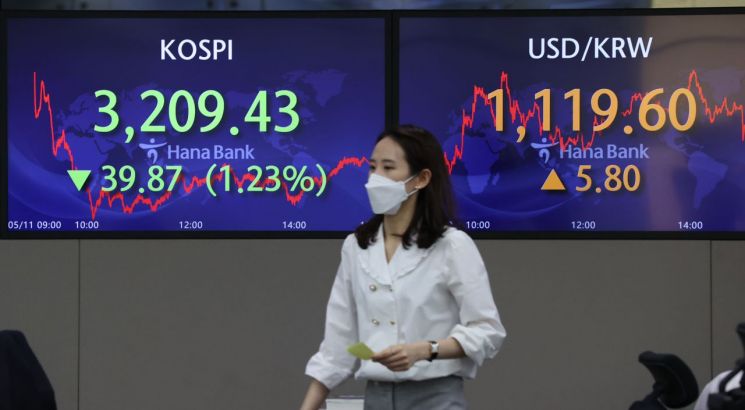
[Asia Economy Reporter Kim Eun-byeol] As concerns about US-origin inflation rise and government bond market yields fluctuate, the Bank of Korea is closely monitoring the market situation. If inflation surges and market interest rates continue to rise, it may become difficult to hold off on raising the base rate. The Bank of Korea currently maintains the historically low base rate of 0.50% per annum, but if the gap between market yields and the base rate widens too much, interest rate distortions could occur.
According to Investing.com, as of 9:56 a.m. today, the yield on the 10-year Korean government bond was trading at 2.166%, surpassing this year's peak of 2.152%. In mid-March, yields hovered between 1.9% and 2% for over a month, but on the 30th of last month, it broke through 2.1%, and today it showed an increase of about 4 basis points (1bp = 0.01 percentage points), although the pace of increase is gradually slowing. The 3-year government bond yield also rose about 1.5bp to trade at 1.144%.
Last night, the US Department of Labor announced that the Consumer Price Index (CPI) for April rose 4.2% compared to the same month last year. This monthly increase is the highest in about 13 years since September 2008, exceeding the 3.6% forecast by experts compiled by Dow Jones. The month-over-month increase (0.8%) also far surpassed the 0.2% forecast by experts compiled by Bloomberg News. Core CPI, which excludes the volatile energy and food sectors, rose 0.9% from March, exceeding the market forecast of 0.3%. The 0.9% month-over-month core CPI increase is the largest since 1982. Compared to the same month last year, it rose 3.0%.
As inflation rose more sharply than expected, US Treasury yields surged (bond prices fell), and Korean government bond yields also showed a synchronized upward trend.
Market participants believe that government bond yields, which have broken through yearly highs, may remain elevated through the second half of the year. This is partly because the government has increased bond issuance to respond to the COVID-19 shock. When more bonds are issued and released into the market, bond prices fall (bond yields rise). The problem is that if inflation surges and the timing of monetary tightening is brought forward more than expected, borrowers with loans will inevitably face increased burdens.
Generally, when bond yields rise, financial bonds, which serve as benchmarks for loan interest rates, may also increase. As of March, the household loan interest rate (newly contracted amount) at deposit banks was 2.88%, up 0.07 percentage points from the previous month.
© The Asia Business Daily(www.asiae.co.kr). All rights reserved.
!["The Woman Who Threw Herself into the Water Clutching a Stolen Dior Bag"...A Grotesque Success Story That Shakes the Korean Psyche [Slate]](https://cwcontent.asiae.co.kr/asiaresize/183/2026021902243444107_1771435474.jpg)
















