Strengthening the Discovery System for the '4th Comprehensive Plan for Solitary Death Prevention'... Comprehensive Support for Prevention and Funeral Services
Targeting Middle-Aged and Older Adults for 54.9% of Solitary Deaths... Special Surveys and Launch of Crisis Detection App Based on Mobile Phone Usage
[Asia Economy Reporter Lim Cheol-young] In response to the increasing trend of single-person households, the Seoul Metropolitan Government is strengthening its measures to prevent solitary deaths. To prevent deaths caused by solitary death or unclaimed deaths presumed to be solitary deaths, the city will enhance systematic identification of socially isolated and at-risk households, providing comprehensive support ranging from care and assistance to public funerals that ensure a dignified end of life.
On the 13th, Seoul announced the '4th Comprehensive Plan for Solitary Death Prevention' to be implemented throughout this year. In addition to existing policies such as Seoul-style emergency welfare linkage and health management services, the plan includes five major policy tasks and 21 projects, focusing on strengthening the identification system and non-face-to-face care. The five major policy tasks are establishing a continuous identification system, supporting living services and linking private resources, post-management of solitary deaths, education and promotion for solitary death prevention, and systematic policy formulation based on solitary death statistics.
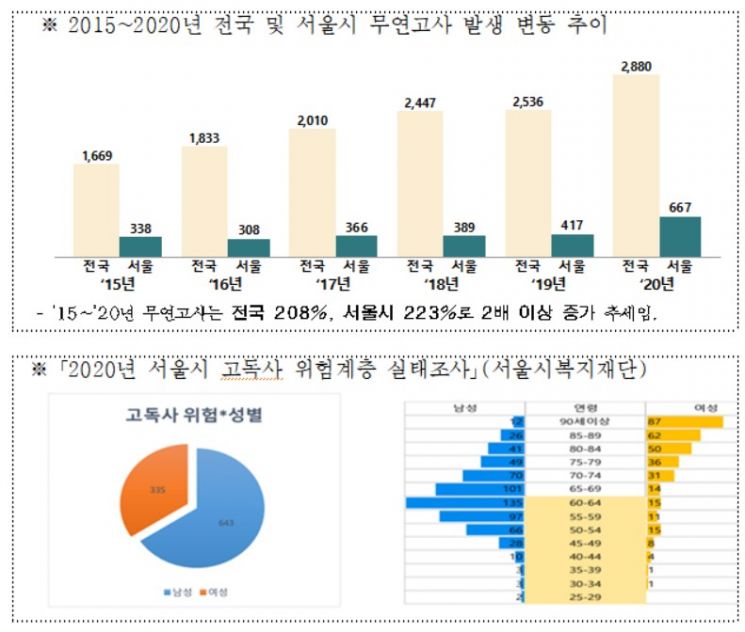
According to an analysis of statistics by neighborhood in 25 autonomous districts by Seoul, 54.9% of solitary deaths that occurred last year were among middle-aged adults (50?64 years old). According to the '2020 Seoul Solitary Death Risk Group Survey' by the Seoul Welfare Foundation, 65.7% of the solitary death risk group were male, and among them, 46.3% were under 64 years old, indicating a relatively high proportion of middle-aged men.
Accordingly, Seoul is establishing a continuous identification system using various full surveys while simultaneously conducting pinpoint investigations for high-risk groups. Starting this year, special management for single-person households living in places such as goshiwon (small, low-cost rooms) and jjimjilbang (Korean sauna) will begin, and in the second half of the year, a special full survey targeting middle-aged single-person households at high risk of solitary death will be conducted.
Considering the characteristics of the solitary death risk group, Seoul is strengthening non-face-to-face care by newly launching the ‘Seoul Salpimi’ app and expanding support for relationship building, education, and emotional healing. The plan supports a return to daily life and self-sufficiency. At the same time, Seoul will continue existing support. Currently, the city classifies solitary death risk groups into three stages (high, medium, low) based on the degree of crisis and provides support accordingly. For economically vulnerable households, Seoul provides up to 900,000 KRW in living expenses through ‘Seoul-style emergency welfare,’ and expands visiting nursing staff to 791 this year to provide health management services.
‘Public funerals,’ first initiated by a local government in 2018, will be further expanded this year beyond the existing seven public funeral halls. The support for funeral hall storage fees (60,000 KRW per day), currently provided only for general unclaimed deceased, will be extended to low-income citizens. Additionally, education and promotion efforts will focus on solitary death prevention to ensure that those who need welfare services do not give up due to lack of information, complicated procedures, or fear of stigma.
Accurate cause and statistical analysis of solitary deaths will be conducted to serve as basic data for systematic policy formulation. Although solitary death has been recognized as a social issue for quite some time, there is still a lack of prior research and statistical data.
Seoul believes that solid data is essential to enhance policy effectiveness and has been conducting a field survey for empirical case analysis of solitary deaths through the Seoul Welfare Foundation since February this year. A research report on the status of solitary death risk groups is scheduled to be published in November. Furthermore, with the full implementation of the autonomous police system in July, Seoul plans to collaborate with autonomous police to receive criminal justice information on presumed solitary deaths and unclaimed death cases, using it as reference material for policies to prevent recurrence.
Kim Seon-soon, Director of Welfare Policy, stated, "We will devote all our efforts to proactively respond to future changes and realize a happy Seoul free from the risk of solitary death."
© The Asia Business Daily(www.asiae.co.kr). All rights reserved.

















