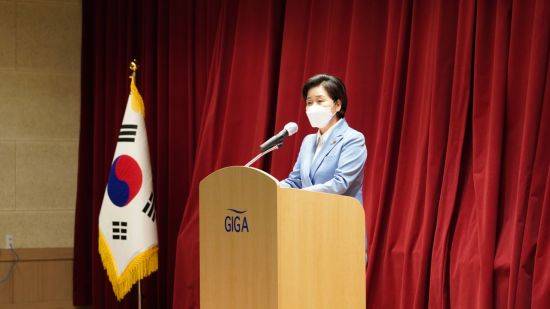
[Asia Economy Honam Reporting Headquarters Reporter Yoon Jamin] Yang Hyang-ja, Member of the National Assembly (Democratic Party of Korea·Gwangju Seo-gu Eul), held a public hearing on the enactment of the "Act on the Promotion and Support of the Future Automobile Industry" at the Gwangju Green Car Promotion Agency on the 12th.
The Future Car Industry Act was promoted based on the judgment that it is necessary to designate future car industry clusters and provide special support so that the regional parts industry can smoothly transition to the future car industry while creating synergy through industrial concentration.
The public hearing, attended by Gwangju Mayor Lee Yong-seop, related organizations, and experts, began with a presentation by Yoo Si-bok, Head of the Autonomous Cooperative Driving Research Center at the Korea Automotive Technology Institute, followed by active discussions on the characteristics of the Future Automobile Industry Act and the necessity of legislation.
In the discussion, Seo Gil-won, Director of the Future Automobile Industry Division at the Ministry of Trade, Industry and Energy, Park Jun-yeol, Director of the Automobile Industry Division of Gwangju City, and Kim Ju-hong, Executive Director of the Korea Automobile Manufacturers Association, participated.
Assemblyman Yang said, "This public hearing is the final opinion-gathering process for the bill created after more than a year of effort."
He added, "Amid rapid industrial restructuring movements, it is a crucial time to examine the current reality of Korea's future car industry and to consider how to systematically foster and support the future car industry going forward. It is necessary to designate and support future car industry clusters to help parts industries centered on complete vehicles smoothly transition to the future car industry and to create synergy through industrial concentration."
Seo Gil-won, Director at the Ministry of Trade, Industry and Energy, said, "Currently, the future car industry is a comprehensive industry that integrates automobiles, ICT, and ITS, and experts believe that it is difficult for existing domestic parts companies to independently succeed in industrial transformation." He added, "The future car industry, represented by CASE (Connected, Autonomous, & Service, Electric Drive), poses challenges to the automobile parts industry, and companies that fail to transform will inevitably be eliminated."
Kim Ju-hong, Executive Director of the Korea Automobile Manufacturers Association, explained, "While global automobile market demand decreased by 14.1% last year due to COVID-19 compared to the previous year, electric vehicles increased by 20% to about 5.26 million units, marking an all-time high. The automobile industry is shifting its paradigm from traditional manufacturing to the mobility industry."
Park Jun-yeol, Director of the Automobile Industry Division of Gwangju Metropolitan City, said, "The Global Motors (GGM) plant in the Gwangju Bitgreen National Industrial Complex has completed its inauguration ceremony and plans to start mass production with an initial annual production of 70,000 SUVs from September this year." He added, "This is the first automobile factory built in Korea in 23 years and the first nationwide labor-management win-win type jobs created for young people."
Meanwhile, the legislative public hearing was attended by about 50 people, including Gwangju Mayor Lee Yong-seop, Song Young-gil, leader of the Democratic Party of Korea, Yoon Ho-jung, floor leader of the Democratic Party of Korea, Park Jin-gyu, Vice Minister of the Ministry of Trade, Industry and Energy, local city and district council members, and local residents.
© The Asia Business Daily(www.asiae.co.kr). All rights reserved.
![Clutching a Stolen Dior Bag, Saying "I Hate Being Poor but Real"... The Grotesque Con of a "Human Knockoff" [Slate]](https://cwcontent.asiae.co.kr/asiaresize/183/2026021902243444107_1771435474.jpg)
















