Party Leader Election Deposit Reduced to 80 Million Won but Entry Barriers Remain
Public Opinion Calls for Measures to Limit Election Expenses
[Asia Economy Reporters Naju-seok and Geum Bo-ryeong] As the schedule for the People Power Party (PPP) leadership election is finalized and declarations of candidacy continue one after another, the burden of 'election costs' has emerged as a key issue. Although challenges from political newcomers such as first-term lawmakers are more active than ever, election costs are acting as a barrier to entry.
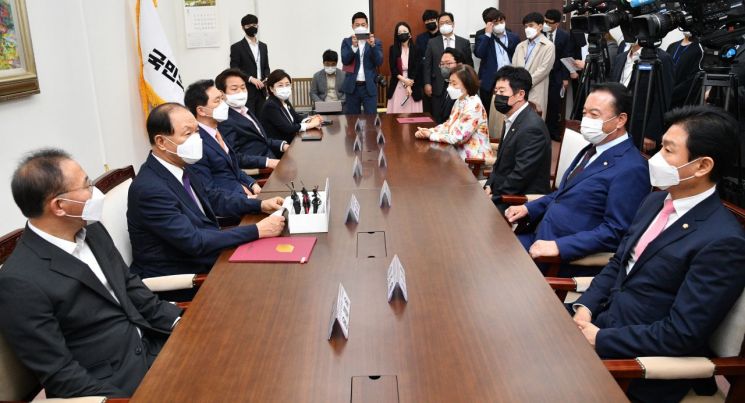 Hwang Woo-yeo, Chairman of the Central Election Commission of the People Power Party, is delivering a greeting at the 1st meeting of the Central Election Commission held on the afternoon of the 11th at the National Assembly in Yeouido, Seoul, for the election of the party leader and supreme council members. [Image source=Yonhap News]
According to political circles on the 12th, it is expected that there will be as many as 10 candidates for the PPP party leader. Lawmakers Cho Hae-jin, Hong Moon-pyo, Yoon Young-seok, Joo Ho-young, and Cho Kyung-tae have already declared their candidacies, while Kwon Young-se, Kim Woong, Kim Eun-hye, and former Supreme Council member Lee Jun-seok have settled on running. There are also strong prospects for former lawmaker Na Kyung-won to enter the race.
What is different from before is that the candidacy atmosphere among political newcomers such as first-term lawmakers is quite distinct from previous PPP leadership contests. However, the issue of election costs, including the deposit, has been pointed out as a problem.
In the past, PPP leadership candidates had to pay a deposit of 100 million KRW, and candidates for Supreme Council member had to pay 50 million KRW. These costs served the purpose of covering internal party election expenses but also acted as a barrier to entry. This is because a significant portion of political donations or personal funds must be used to cover these costs. One party leadership candidate pointed out, "If you run in the primary, you have to produce leaflets, send text messages, travel nationwide, and operate an office, which costs hundreds of millions of won. Then, there is no political donation left, making it difficult to carry out policy activities," adding, "In the end, only those with money can become party leader, or they have to fill their pockets elsewhere."
With this awareness of the problem, first-term PPP lawmakers have conveyed to the party's election commission the opinion that 'the deposit should be lowered to near actual expenses.' Reflecting this demand to some extent, the election commission reduced the party leader deposit to 40 million KRW for the preliminary round and 40 million KRW for the final round, totaling 80 million KRW. However, criticism that the burden remains heavy continues. PPP lawmaker Park Soo-young pointed out, "In the past, elections were held in gymnasiums nationwide with people mobilized, but the situation has changed after experiencing COVID-19."
There are also calls to consider ways to reduce election costs themselves beyond the deposit. A political insider said, "We need to consider limiting the number of text message transmissions and utilizing online leaflets." The insider added, "In the past, politicians receiving illicit political funds was mostly due to internal party elections," emphasizing, "Efforts to prevent such abuses are required."
© The Asia Business Daily(www.asiae.co.kr). All rights reserved.

















