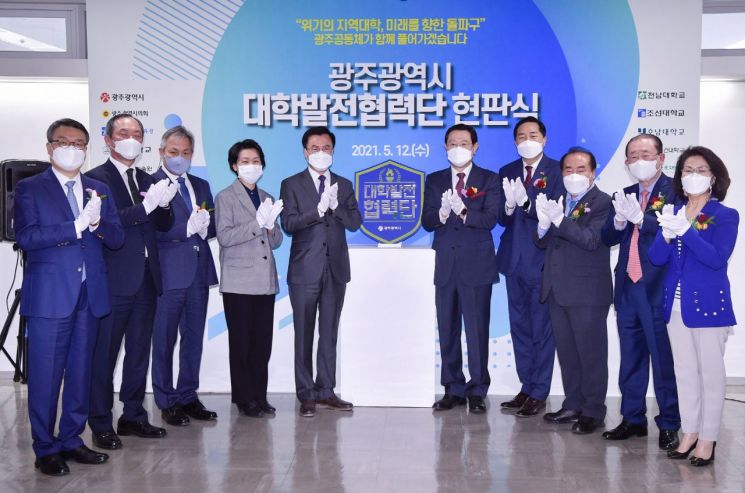
[Asia Economy Honam Reporting Headquarters Reporter Park Seon-gang] Gwangju Metropolitan City held the "University Development Cooperation Group (T/F Team) Launch Ceremony" on the 12th at the City Hall Business Room.
The "University Development Cooperation Group" was newly established directly under the Deputy Mayor to address the current crisis faced by local universities due to low freshman enrollment, recognizing that the crisis of universities is also a crisis for the local community, and to unite Gwangju City and the local community to solve these issues.
In particular, 10 personnel, including representatives from five universities in the area and staff dispatched from the City Office of Education, will be stationed at the office prepared on the 12th floor of City Hall to monitor the status of each university and carry out communication and related tasks.
Earlier, on April 8, Gwangju City, the City Council, the City Office of Education, and 17 local universities signed a Memorandum of Understanding (MOU) for crisis response and mutual cooperation among local universities.
Attending the plaque ceremony were Mayor Lee Yong-seop, City Council Chairman Kim Yong-jip, National Assembly member Yoon Young-duk, Gwangju Metropolitan Office of Education Superintendent Jang Hwi-guk, Ministry of Education Higher Education Policy Director Choi Eun-ok, Chonnam National University President Jeong Seong-taek, Chosun University President Min Young-don, Gwangju University President Kim Hyuk-jong, Honam University President Park Sang-cheol, and Donggang University President Lee Min-sook.
This year, the University Development Cooperation Group plans to jointly explore ways to enhance competitiveness tailored to the characteristics of each university regarding various issues such as low freshman enrollment and employment problems faced by local universities, and to identify short- and long-term tasks to establish an annual implementation roadmap.
To this end, campus-by-campus touring forums will be held until the end of the year to present each university's strengths, challenges to overcome, and survival strategies, sharing the realities of local universities through expert advice. Additionally, the scope of support from Gwangju City will be determined to discover practical joint agendas for overcoming the crisis of local universities.
Furthermore, the group will serve as a control tower to reorganize and efficiently allocate 28 university support-related projects scattered across various departments, ensuring they effectively contribute to strengthening the competitiveness of local universities.
In the long term, to create a virtuous cycle where youth jobs expand locally and talented individuals are attracted to the region by securing competitiveness for each local university, the group will promote projects such as ▲introducing customized vocational education systems linked to regional key industries like artificial intelligence, future vehicles, and renewable energy ▲efforts to improve related laws and systems to ensure the effectiveness of local university development policies ▲increasing employment rates of local talents in public institutions and companies ▲joint discovery of central government R&D and public project opportunities ▲transitioning to lifelong vocational education institutions including re-education for workers ▲supporting freshman (including international student) recruitment.
Additionally, the University Development Cooperation Group, currently operating as a standing working-level council (T/F), will be expanded and reorganized into a permanent organization starting next year to establish a promotion system.
Gwangju City expects the "University Development Cooperation Group" to function as an innovation network that encompasses innovation actors and establishes effective measures contributing to the revitalization of local universities.
Mayor Lee Yong-seop said, "With the low birthrate issue leading to a decrease in school-age population, under-enrollment of university freshmen, and escalating regional crises, we must unite tightly to overcome this crisis," adding, "Please gather strength and wisdom from the local community to produce meaningful innovative outcomes by using the University Development Cooperation Group as a focal point."
© The Asia Business Daily(www.asiae.co.kr). All rights reserved.

















