Formation of Labor Unions for Office Research Positions in Large Corporations Continues
2030 'MZ Generation' Core Members and Executives
Value Communication and Transparency, Not Seeking Lifetime Employment
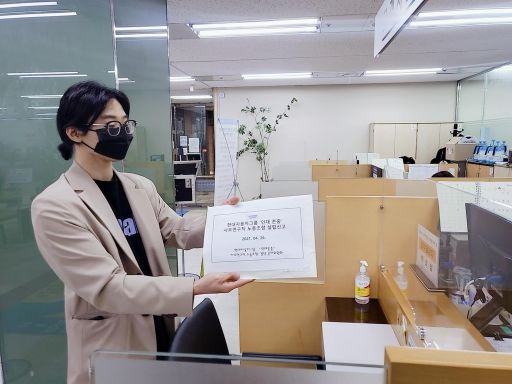 Hyundai Motor Group 'Respect for Talent' Office Research Workers' Union Chairman Lee Geon-woo submitted the union establishment report on the 26th of last month.
 [Image source=Yonhap News]
[Asia Economy Reporter Kim Choyoung] "Isn't it common sense, not an unreasonable demand, to be rewarded according to the effort put in?"
The movement to establish labor unions among office workers, led by the MZ generation (those born from the 1980s to the early 2000s), is spreading in earnest. Starting with LG Electronics in March, office worker unions officially launched last month at Kumho Tire and Hyundai Motor Group, and Hyundai Heavy Industries and Nexen Tire announced plans to establish unions within this year.
The MZ generation's demand for fair compensation and their move to form unions is analyzed to reflect the disappearance of the concept of lifelong employment and the MZ generation's characteristics that emphasize communication and transparency.
On the 29th of last month, the Hyundai Motor Group 'Respect for Talent' office research staff union received a certificate of union establishment from the Seoul Regional Employment and Labor Office, allowing them to officially exercise rights under the Labor Union Act. Currently, about 500 Hyundai Motor Group employees have expressed their intention to join the office worker union, with the majority being MZ generation employees with less than eight years of service.
The establishment of the office worker union at Hyundai Motor Group began as dissatisfaction with performance bonuses accumulated among MZ generation employees. Despite recording the highest sales ever, the wage and collective agreement (wage and collective bargaining) settled at a level lower than last year: 'basic salary freeze + 150% performance bonus + 1.2 million KRW COVID-19 crisis recovery incentive.' The MZ generation, who value compensation proportional to effort, were angered by this decision, considering it unreasonable.
The movement to form unions led by the MZ generation has already become a trend in society. Following the launch of LG Electronics' 'People-Centered' office worker union in March, whose entire executive team consists of MZ generation members, Kumho Tire and Hyundai Motor Group joined the ranks of office worker unions last month. Hyundai Heavy Industries and Nexen Tire aim to establish unions within this year.
The reason the MZ generation not only expresses dissatisfaction but also moves to establish unions is attributed to the disappearance of the lifelong employment concept.
A survey conducted by the job platform 'Saramin' targeting 611 MZ generation job seekers found that 6 out of 10 (61.5%) do not aim to stay at their first job until retirement. The MZ generation, who do not hope for retirement at their first job, do not hesitate to express dissatisfaction when faced with unfair situations. Feeling no need to sacrifice the present for the future, the MZ generation actively responds to issues such as performance bonuses by forming unions.
Lee Gunwoo, chairman of Hyundai Motor Group's 'Respect for Talent' office research staff labor union, stated when submitting the union establishment report on the 26th of last month, "We hope to participate in the formation and operation of a TFT for the revision of the evaluation and compensation system," signaling that the office research staff union will actively intervene in the revision of performance bonuses.
Professor Choi Youngwoo of the Korea Employment and Labor Education Institute explained, "The MZ generation strongly perceives the company as 'a place they can leave at any time, even tomorrow.' While previous generations endured with the expectation of eventual rewards such as promotions, the MZ generation believes that compensation proportional to effort should be immediate."
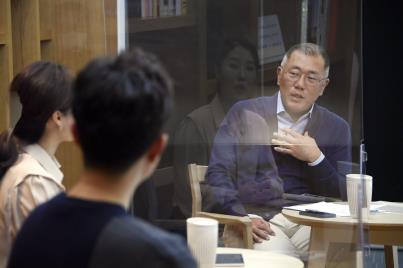 Chairman Chung Euisun of Hyundai Motor Group during a town hall meeting last March. Chairman Chung acknowledged the dissatisfaction with performance bonus compensation within the group, stating, "I realized that the previous compensation and communication methods did not meet the expectations of all employees," and promised to manage performance bonuses and personnel matters more accurately and thoroughly. [Image source=Yonhap News]
The MZ generation's values emphasizing communication and transparency are also cited as reasons for their union formation. Unlike the 586 generation (people in their 50s, who entered university in the 1980s, born in the 1960s) unions that confronted through strikes and sit-ins, the MZ generation prioritizes asserting their opinions based on clear communication.
The communication methods of existing unions likely appeared somewhat inefficient to them. Additionally, the MZ generation, sensitive to transparency, demands "understandable compensation based on transparent payment criteria" regarding wages and performance bonuses.
A representative case is when an employee named Kim, in his fourth year at SK Hynix, sent a protest email to President Lee Seokhee and all employees in January. At that time, SK Hynix announced it would pay PS (profit sharing) for 2020 at 20% of the annual salary, which sparked dissatisfaction among employees who felt the compensation was insufficient. Although operating profit increased by 84% compared to the previous year, the amount was similar to the poor performance in 2019.
Employee Kim sent an email to President Lee and all employees publicly protesting, saying, "When I joined, the HR manager said they were confident in providing wages and bonuses comparable to Samsung, so why are you not keeping that promise?" Other employees also demanded the disclosure of EVA (Economic Value Added), the indicator used to calculate performance bonuses.
Similar demands followed at Samsung Electronics. When Samsung Electronics announced the performance bonus payment criteria in January, employees in the DS division, responsible for semiconductors, immediately protested, saying, "Despite achieving the highest operating profit last year, the compensation is not appropriate." The Samsung Group Labor Union Coalition also held a press conference, raising their voices that "the criteria and payment methods are opaque, ambiguous, and applied in a way unfavorable to workers."
Experts suggest that such movements by the MZ generation are desirable and should be accepted from the management's perspective.
Professor Choi Youngwoo of the Korea Employment and Labor Education Institute analyzed, "The union formation movement among the MZ generation, who have a strong desire for respect and value compensation for performance, is a natural phenomenon. If management recognizes and accepts this new paradigm, positive effects can certainly be expected."
Professor Kim Gichan of the Catholic University Business School diagnosed, "For the MZ generation, unions were created not for conflict but for communication. As the proportion of the MZ generation within companies increases, such movements are desirable and necessary."
© The Asia Business Daily(www.asiae.co.kr). All rights reserved.


















