Korea Institute of Civil Engineering and Building Technology Releases Monitoring Results After Installation in Front of DDP
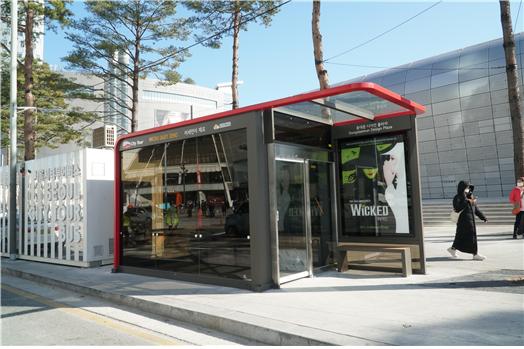
[Asia Economy Reporter Kim Bong-su] A bus stop has been developed where people inside can avoid fine dust and exhaust fumes.
On the 12th, the Korea Institute of Civil Engineering and Building Technology announced that it has developed a "Zero Fine Dust Bus Stop Using Plants" with fine dust purification functions to protect citizens from fine dust and exhaust fumes.
Existing bus stops were structured in a way that citizens waiting for vehicles inevitably inhaled exhaust fumes directly. Citizens have been continuously exposed to fine dust and exhaust fumes emitted from aging buses, suffering discomfort and sometimes causing direct or indirect respiratory diseases.
Dr. Moon Soo-young’s research team at the institute applied an air purification system to the bus stop that reduces pollutants entering the bus stop and purifies the fine dust and exhaust fumes that do enter. The fine dust zero bus stop developed by the institute purifies the air using plants and filters, reducing fine dust by up to 50% even in outdoor open spaces.
Fine dust and ultrafine dust are so small that they are barely visible to the naked eye, but they penetrate the body through the skin and respiratory system, causing various diseases. According to the 2018 National Environmental Awareness Survey released by the Korea Environment Institute, 3 out of 10 citizens reported having suffered from various diseases due to fine dust. High concentrations of fine dust occur seasonally from December to February every year. Moreover, road dust is generated daily regardless of the season. According to Singaporean researchers, air pollution in areas where public transportation is congested, such as bus stops, is about 3.5 times higher than general urban air, making these locations seriously affected by fine dust and air pollution.
The institute installed this system at the City Tour bus stop in front of Dongdaemun Design Plaza (DDP) and conducted a pilot operation, confirming that the amount of fine dust in the indoor air of the bus stop was reduced by 60% compared to outdoors. Last month, empirical monitoring of fine dust reduction functions showed an average reduction of 43% for fine dust (PM10) and 45% for ultrafine dust (PM2.5).
This "Zero Fine Dust Bus Stop" was first installed at the bus stop in front of Hanyang University Station in 2018 and was installed at the City Tour bus stop in front of DDP last December, operating mainly on weekends. In the future, it is planned to be partially applied during the construction of the "Barrier-Free Smart Boarding Platform" supplied to the Busan area starting in 2021.
Dr. Moon Soo-young said, "We plan to supplement the commercialized zero fine dust bus stop with a modular system and strengthen the operation system to flexibly respond to various disaster situations. We will provide bus stops that minimize costs to ensure they can be built and maintained nationwide economically."
© The Asia Business Daily(www.asiae.co.kr). All rights reserved.
![Clutching a Stolen Dior Bag, Saying "I Hate Being Poor but Real"... The Grotesque Con of a "Human Knockoff" [Slate]](https://cwcontent.asiae.co.kr/asiaresize/183/2026021902243444107_1771435474.jpg)
















