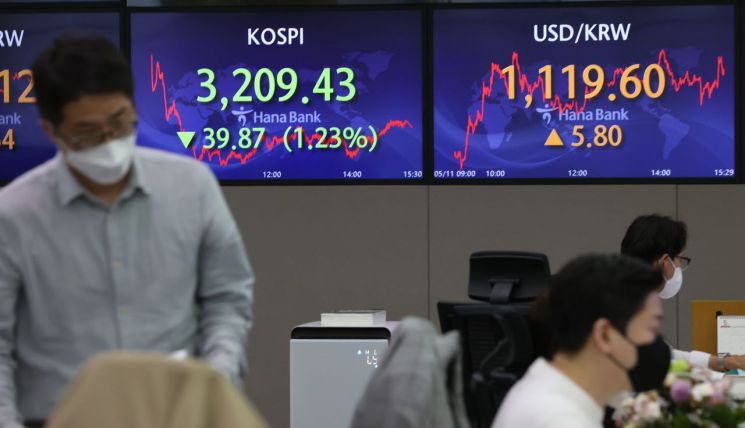
[Asia Economy Reporter Lee Seon-ae] On the 12th, the domestic stock market showed a slight decline, influenced by the downturn in the U.S. stock market. While individuals and institutions showed a buying preference, foreigners were solely on the selling side.
As of 9:19 AM, the KOSPI index recorded 3,207.76, down 0.06% from the previous day. The KOSDAQ index was down 0.02% at 978.40.
In the KOSPI market, individuals were net buyers with about 141.6 billion KRW, and institutions also showed a buying preference of approximately 121.3 billion KRW. In contrast, foreigners were net sellers with about 274.1 billion KRW. In the KOSDAQ market, individuals were net buyers with about 39.7 billion KRW, while foreigners and institutions were net sellers with approximately 32.2 billion KRW and 5.1 billion KRW, respectively.
By sector in the KOSPI, most sectors showed a decline, including pharmaceuticals (-0.13%), paper and wood (-0.08%), and electricity and gas (-0.08%), while some sectors such as machinery (+0.28%), distribution (+0.24%), and non-metallic minerals (+0.09%) showed strength.
In the KOSDAQ sectors, digital content (-0.53%), publishing and media reproduction (-0.23%), and other services (-0.15%) declined, whereas food and tobacco (+0.41%), medical and precision instruments (+0.13%), and telecommunications equipment (+0.11%) rose.
Meanwhile, the New York stock market was volatile overnight. On the 11th (local time) at the New York Stock Exchange (NYSE), the Dow Jones Industrial Average closed down 473.66 points (1.36%) at 34,269.16. The Standard & Poor's (S&P) 500 index fell 36.33 points (0.87%) to 4,152.10, and the Nasdaq index closed down 12.43 points (0.09%) at 13,389.43.
Investors were concerned that improving economic indicators worldwide, including Europe and China, could accelerate inflation. Some investors worried that this inflation rise might trigger an early tightening by the Federal Reserve. Reflecting these inflation concerns, the Chicago Board Options Exchange (CBOE) Volatility Index (VIX), known as Wall Street’s ‘fear index,’ rose to 23.73, marking its highest level since March 10. The U.S. 10-year Treasury yield also surpassed 1.62% during the session.
Seo Sang-young, a researcher at Mirae Asset Securities, said, "Industrials, consumer goods, and financial stocks, which had been strong due to expectations of economic normalization, showed weakness. Considering the rising inflationary pressures, it is necessary to closely monitor whether selling pressure on related companies continues."
© The Asia Business Daily(www.asiae.co.kr). All rights reserved.
![From Bar Hostess to Organ Seller to High Society... The Grotesque Con of a "Human Counterfeit" [Slate]](https://cwcontent.asiae.co.kr/asiaresize/183/2026021902243444107_1771435474.jpg)
















